 Yoga Teacher Registration in Canada: RYT-200, RYT-500, Requirements & Fees
Yoga teacher registration in Canada is an important consideration for anyone who has completed yoga teacher training and wants to establish professional credentials.
Whether you have completed a 200-hour yoga teacher training program, earned an advanced 500-hour qualification, or have years of practical teaching experience, understanding registration can help you make informed decisions about your professional future.
But the process can be confusing.
What is the difference between yoga teacher certification and registration? Do you need an RYT-200 or RYT-500? Does your training school need to be registered? Can you apply with an online or international yoga certificate? How much does registration cost?
This comprehensive resource from Yoga Alliance International answers these questions and connects you to detailed guides covering the various stages of yoga teacher registration.
The goal is to make the process understandable, accessible and transparent.
1. Understanding Yoga Teacher Registration in Canada
Yoga teaching is not a provincially regulated profession in Canada in the same way as medicine, physiotherapy or certain other healthcare occupations.
There is no general federal or provincial government licence required simply to describe yourself as a yoga teacher.
However, completing a training program and registering professional credentials are two different things.
Yoga teacher certification generally refers to a certificate awarded after successfully completing a training program.
Yoga teacher registration means that a professional registry has reviewed your qualifications and accepted you under its published standards.
For example, someone may complete a 200-hour yoga teacher training program and receive a certificate from their school.
They can then apply to a yoga teacher registry for recognition as a Registered Yoga Teacher, commonly abbreviated RYT.
Registration provides a way for studios, students and potential employers to identify the qualifications that a particular registry has reviewed.
It does not create a government licence or guarantee employment.
Several organizations offer yoga teacher registration, including Yoga Alliance in the United States, the Canadian Yoga Alliance and Yoga Alliance International.
Each organization maintains its own standards, application procedures and membership requirements.
Related articles
- Yoga Certification vs. Yoga Registration in Canada: What’s the Difference? — Understand the distinction between completing training and holding a registered designation.
- What Does RYT Actually Mean? The Honest Guide to Yoga Teacher Registration — A detailed explanation of the RYT designation.
- What Does It Mean to Be a Registered Yoga Teacher? — Learn what registration represents and how it fits into a teaching career.
- What Is an RYT-200 and Do You Actually Need One to Teach Yoga in Canada? — Explore the practical value of the foundational designation.
Understanding these distinctions is the first step toward choosing a registry that matches your qualifications and professional objectives.
2. RYT-200 Registration: Requirements for New Yoga Teachers
The RYT-200 designation is a common starting point for yoga teachers who have completed foundational training.
RYT stands for Registered Yoga Teacher, while 200 refers to the minimum number of training hours associated with the qualification.
A typical 200-hour program introduces students to several core areas of yoga education.
These generally include:
- Yoga postures, movement and practical techniques
- Anatomy and physiology
- Breathing practices and meditation
- Yoga history and philosophy
- Teaching methodology and class sequencing
- Ethics, communication and student safety
- Practical teaching experience
The objective is to provide a foundation for responsible instruction.
Yoga Alliance International RYT-200 requirements
Applicants seeking RYT-200 registration through Yoga Alliance International must demonstrate qualifying foundational yoga education.
The organization recognizes several possible pathways.
Pathway 1: Training with a Yoga Alliance International registered school
Applicants may submit evidence of completing a qualifying 200-hour program registered with Yoga Alliance International.
Pathway 2: Training with another recognized yoga organization
Applicants may qualify through a recognized yoga teacher training program completed online or in person.
Yoga Alliance International publishes a list of recognized international organizations, including several yoga alliances operating in Canada, the United States, Europe, Australia and New Zealand.
Pathway 3: Equivalent education and experience
Teachers with substantial experience or equivalent education may be considered through the organization’s applicable assessment or grandfathering procedures.
For the standard RYT-200 pathway, Yoga Alliance International does not require a minimum number of post-training teaching hours.
Applicants should review the official RYT-200 registration requirements before applying.
Related articles
- How to Register as an RYT-200 Yoga Teacher in Canada: Requirements, Documents and Fees — A detailed guide to preparing and submitting an RYT-200 application.
- How to Become a Registered Yoga Teacher in Vancouver — A regional guide for teachers working in British Columbia.
- How to Choose a Yoga Teacher Training in Canada: What Registries Actually Look For — Understand the training qualities and documentation registries may examine.
For many new teachers, RYT-200 registration provides an appropriate first professional credential.
3. RYT-500 Registration: Advanced Yoga Teacher Qualifications
RYT-500 is an advanced Registered Yoga Teacher designation associated with a minimum of 500 hours of qualifying training.
Many teachers begin with a 200-hour program and later undertake an additional 300-hour advanced training.
Other qualifying training pathways may also be accepted depending on the registry’s specific standards.
Advanced programs may explore teaching methodology, anatomy, philosophy, sequencing and specialized practices in greater depth.
Who should consider RYT-500?
RYT-500 may be suitable for teachers who want to:
- Expand their understanding of yoga teaching methodology
- Complete advanced professional development
- Demonstrate a higher level of formal yoga education
- Prepare for certain specialized teaching opportunities
- Continue progressing toward experienced-teacher qualifications
An RYT-500 designation does not automatically make someone a more effective teacher than an RYT-200 instructor.
Teaching competence also depends on experience, communication, safety awareness and ongoing professional development.
Yoga Alliance International RYT-500 requirements
The published RYT-500 standards recognize qualifying 200-hour and 300-hour training combinations from accepted programs and organizations, together with an applicable equivalent-training pathway.
The standard RYT-500 designation does not require a separate minimum number of teaching hours under the organization’s published requirements.
This distinguishes RYT-500 from experienced-teacher designations, which specifically require documented professional teaching experience.
Review the complete RYT-500 registration standards to determine whether your existing education qualifies.
Related articles
- How to Upgrade From RYT-200 to RYT-500 in Canada: Training Hours, Requirements and Registration — A practical guide to progressing from foundational to advanced registration.
- RYT-200 vs. RYT-500: What’s the Difference and Which Credential Do You Actually Need? — Compare the two registration levels.
- RYT-500 vs. RYT-200: Which Yoga Teacher Credential Do You Need? — Additional guidance on training requirements and professional goals.
Teachers should evaluate advanced training according to its educational value, not simply the additional letters it may place after their name.
 4. Can You Register With Online, International or Unregistered Yoga Training?
One of the most common registration questions concerns where and how a teacher completed their education.
Some teachers attend in-person programs at established studios.
Others complete hybrid courses combining online learning and practical instruction.
Some graduate from fully online programs.
International training is also common, particularly in destinations such as India, Bali and Thailand.
The important question is whether the specific registry accepts the training and whether the applicant can provide the necessary evidence.
Online and hybrid yoga teacher training
Yoga Alliance International accepts applications from graduates of qualifying online, hybrid and in-person training programs.
However, acceptance of an online training format does not mean every program is automatically approved.
The organization may review the curriculum, training documentation and teaching competence according to its published standards.
Other registries may apply different eligibility rules.
Training completed outside Canada
A yoga teacher who completed education abroad may be eligible to register in Canada.
The relevant considerations include training hours, curriculum, issuing institution and any supporting documentation required by the registry.
International training should be evaluated against the standards of the organization with which the teacher intends to register.
What if your school is not registered?
An unregistered school does not necessarily mean the teacher received inadequate education.
However, school registration status can affect eligibility with particular registries.
For example, Yoga Alliance USA has requirements linking its RYT pathway to training completed through appropriately registered schools.
Yoga Alliance International offers broader application pathways, subject to eligibility review.
Applicants should not assume that approval with one registry guarantees acceptance by another.
Related articles
- Can You Register as an RYT-200 After Completing Online Yoga Teacher Training? — Online training eligibility and documentation.
- Can You Register as an RYT-200 If Your Yoga School Isn’t Registered? — Registration options for graduates of non-registered schools.
- Is Your Yoga Teacher Certification From India, Bali or Abroad Recognized in Canada? — A guide to overseas qualifications.
- How to Check If a Yoga School Is Registered: RYS Credentials and Standards — Learn how to verify school registration before beginning training.
The most important step is to confirm eligibility before paying registration fees or enrolling in additional training.
5. Documents Needed for Yoga Teacher Registration
Preparing the correct documentation can make the registration process more straightforward.
Requirements vary according to designation and application pathway.
A standard application may require identification and contact details, together with documentation showing the applicant’s yoga training.
Training certificates
Your training certificate should ideally identify:
- Your name
- The issuing school or organization
- The program completed
- The number of training hours
- The completion date
Additional materials may be requested when a certificate does not clearly establish the relevant details.
Curriculum and training records
Applicants may need to provide supporting educational information.
This could include course outlines, syllabi, records of practical instruction or additional training certificates.
Teaching experience documentation
Experience records are especially important for experienced-teacher designations and applications based on substantial professional experience.
Useful evidence can include class logs, employment records, teaching schedules, contracts and reference letters.
What if your original certificate is missing?
Losing a yoga training certificate does not necessarily mean your training cannot be verified.
Teachers can contact their original school, request replacement records or provide alternative evidence where the registry permits it.
The appropriate approach depends on the documents available and the registration standards being applied.
Related articles
- Yoga Teacher Certification Lost or Missing? How to Verify Your Training and Register in Canada — What to do when your original training certificate cannot be located.
- How to Document Yoga Teaching Hours in Canada: Teaching Logs, Proof of Experience and E-RYT Registration — Maintaining and reconstructing professional teaching records.
Keep digital copies of training certificates, continuing education records and relevant teaching documentation in one organized location.
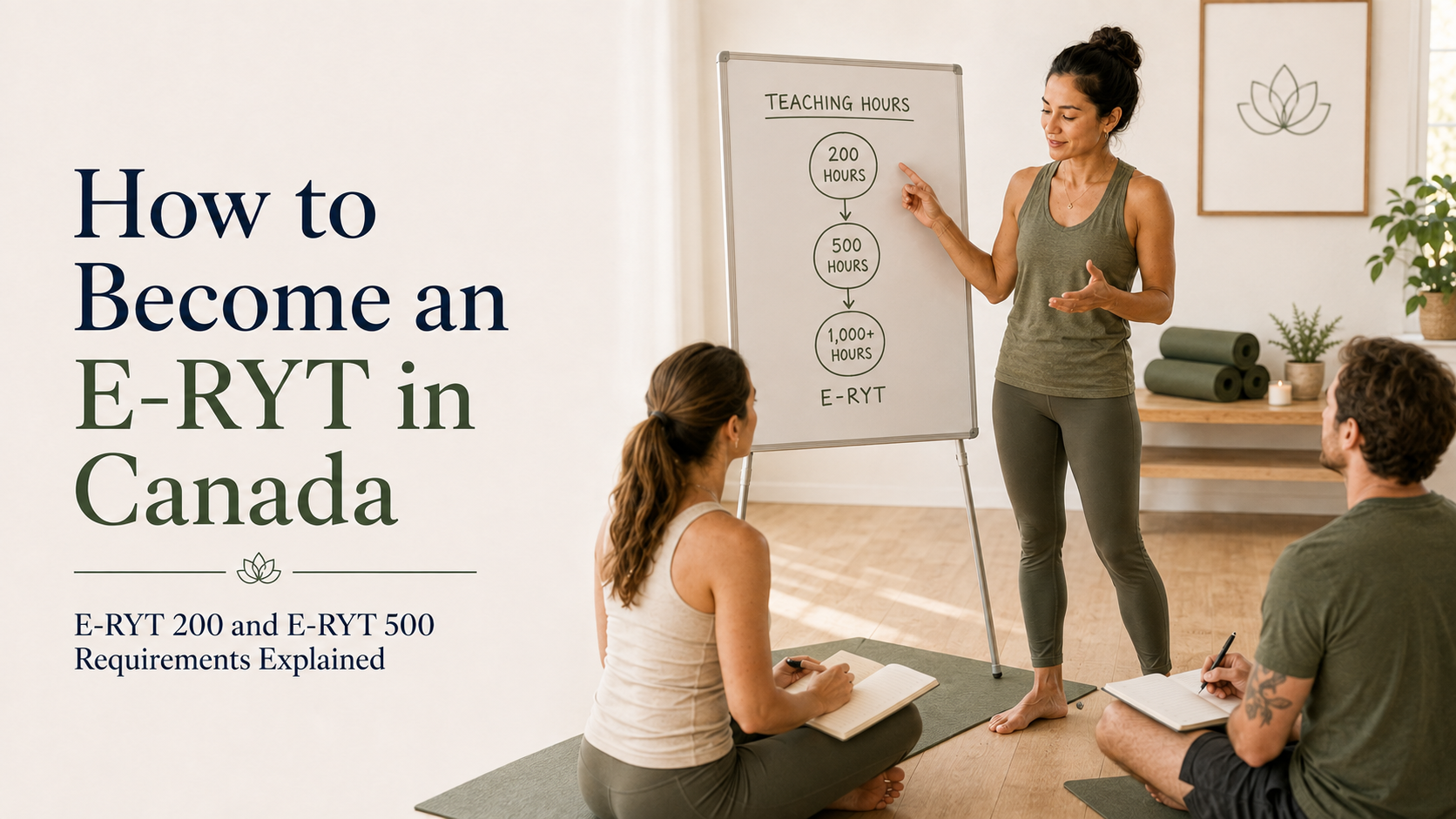
6. Experienced Yoga Teacher Registration: E-RYT-200 and E-RYT-500
Experienced Registered Yoga Teacher credentials recognize instructors who have accumulated substantial teaching experience after completing qualifying training.
The designation is commonly abbreviated E-RYT.
The requirements differ from those for standard RYT registration.
E-RYT-200
Yoga Alliance International’s published E-RYT-200 standard requires:
- A qualifying minimum 200-hour training background
- At least two years of teaching experience
- A minimum of 1,000 documented teaching hours
Teaching hours must be accumulated after completing the qualifying foundational training.
E-RYT-500
The organization’s E-RYT-500 standards include qualifying advanced training and a higher level of practical teaching experience.
The published experience standard is 2,000 teaching hours and four years since the qualifying certificate.
Experienced designations may be particularly relevant to teachers pursuing senior instructional roles or teacher-training responsibilities.
Applicants should consult the official E-RYT-200 and E-RYT-500 pages before applying.
Related articles
- How to Become an E-RYT in Canada: E-RYT-200 and E-RYT-500 Requirements Explained — A detailed explanation of experienced-teacher registration.
- How to Document Yoga Teaching Hours in Canada — Practical methods for recording classes and verifying experience.
- How to Become a Yoga Teacher Trainer in Canada: Lead Trainer Requirements, Experience and Credentials — A related guide to progressing into teacher education.
Teachers who anticipate applying for experienced designations should begin documenting their teaching hours early in their careers.
7. Yoga Teacher Grandfathering: Recognition for Experienced Instructors
Not every qualified yoga teacher followed a conventional 200-hour or 500-hour training pathway.
Some instructors began teaching before modern registry systems became widespread.
Others developed their education through mentorship, independent study, traditional instruction or a combination of professional experiences.
Grandfathering is an alternative registration pathway intended to evaluate qualifying experience and competence.
It is not automatic registration.
How Yoga Alliance International grandfathering works
Under its currently published grandfathering standards, Yoga Alliance International offers an experience-based pathway for RYT-200 and RYT-500.
The published criteria include:
RYT-200 grandfathering
- At least two years of teaching experience
- Approximately 300–500 teaching hours
- Verifiable experience
- Required competency assessment
RYT-500 grandfathering
- At least four years of teaching experience
- Approximately 800–1,000 teaching hours
- Verifiable experience
- Required competency assessment
These requirements are specific to the grandfathering pathway and should not be confused with standard training-based registration.
The organization’s current grandfathering page states that this particular pathway applies to RYT-200 and RYT-500 rather than E-RYT or yoga therapy credentials.
Applicants may need to provide references, teaching records and evidence of practical competence.
Related articles
- How Grandfathering With Yoga Teacher Registration Works — A detailed introduction to experience-based registration.
- How to Document Yoga Teaching Hours in Canada — Build records that support experience-based applications.
Review the official Yoga Alliance International Grandfathering Pathway for current eligibility details.
8. Yoga Teacher Registration Fees in Canada
Registration fees are an important consideration, particularly for teachers who want to maintain professional credentials over several years.
Yoga registries use different membership and fee structures.
Some charge an application fee followed by annual membership dues.
Others offer multi-year registration options.
Yoga Alliance International registration fees
The organization’s published teacher-registration fees are:
| Registration period | Fee |
|---|---|
| 1 year | $50 CAD |
| 3 years | $120 CAD |
| 5 years | $175 CAD |
These published prices apply to teacher credentials.
All fees are in Canadian dollars.
Applicants should review the official fee schedule before payment because registration prices and policies can change.
Understanding registration costs
When comparing yoga teacher registries, consider more than the first-year fee.
Questions worth asking include:
- Is there a separate application charge?
- What are the renewal costs?
- Are multi-year memberships available?
- Are fees charged in Canadian or US dollars?
- Does changing designation involve an additional fee?
- Are continuing education requirements associated with maintaining registration?
Membership price alone should not determine which organization you choose.
Also consider eligibility, professional standards, reputation, services and the requirements of potential employers.
Related articles
- RYT-200 Cost Comparison: Yoga Alliance vs. Yoga Alliance International vs. Yoga Alliance Canada — Compare registration fees and membership structures.
- Yoga Alliance vs. Yoga Alliance Canada vs. Yoga Alliance International: What’s the Real Difference? — Examine differences in standards, recognition and professional registration.
For current pricing, visit Yoga Alliance International Registration Fees.
 9. How to Apply for Yoga Teacher Registration
Once you have selected the appropriate designation and confirmed eligibility, the next step is submitting your application.
Yoga Alliance International provides an online application process.
Step 1: Choose your designation
Determine whether you are applying for RYT-200, RYT-500 or an appropriate experienced-teacher designation.
Review the applicable standards before selecting an option.
Step 2: Gather your documents
Prepare your training certificates and relevant supporting information.
Experienced applicants should also assemble teaching records.
Applicants using alternative pathways may need additional evidence of training or practical competence.
Step 3: Submit your application
Complete the online application and provide the requested information.
The organization’s published standard registration process allows applicants to submit an application for review before paying the registration fee.
Step 4: Complete any required assessment
Yoga Alliance International publishes a competency-assessment process for evaluating teaching ability.
Depending on the applicable pathway, this may involve supporting educational records, a teaching demonstration or other evidence.
Applicants should consult the current assessment requirements for their designation.
Step 5: Receive an application decision
Submitted qualifications are evaluated against the relevant standards.
If additional information is needed, applicants may be asked to provide clarification or further evidence.
Approval is not automatic.
Step 6: Complete registration and payment
Once approved, follow the registration instructions and pay the applicable fee.
Successful applicants receive confirmation of their registration and associated credential information.
The organization also maintains a registry through which teacher credentials can be verified.
Official application resources
- Yoga Teacher Registration Standards
- RYT-200 Requirements and Application
- RYT-500 Requirements and Application
- How Assessment Works
- Registration Fees
Before submitting payment, confirm which documents and assessment requirements apply to your specific registration pathway.
10. Maintaining Your Registration: Renewals, Continuing Education and Professional Standards
Registration is not simply a one-time administrative decision.
Teachers should understand the obligations associated with maintaining an active designation.
These may include renewing membership, keeping contact information accurate, following professional conduct standards and satisfying applicable continuing education expectations.
Registration renewal
Yoga Alliance International offers one-year, three-year and five-year teacher-registration periods.
Teachers should track their renewal dates and keep their professional information current.
An expired membership can affect the status of a public registry listing.
However, a lapsed registration does not erase the original education a teacher completed.
Continuing education
Continuing education allows instructors to expand their knowledge and maintain professional development.
Requirements vary by registry and credential.
Teachers should consult their applicable designation standards rather than assume every yoga organization uses identical requirements.
Potential areas of professional development include anatomy, teaching methodology, yoga philosophy, ethics, student safety and specialized instruction.
Professional conduct
Registered teachers are expected to respect professional boundaries and represent their qualifications accurately.
Safe instruction requires attention to student needs, informed consent, appropriate modifications and clear communication.
Registration does not provide authorization to diagnose medical conditions or practice regulated healthcare professions.
Related articles
- Yoga Teacher Registration Renewal in Canada: Fees, Requirements and What Happens If You Let It Lapse — Maintaining active registration and understanding lapses.
- Yoga Teacher Continuing Education Requirements in Canada: How Many Hours Do You Need? — Comparing continuing education expectations.
- Yoga Teacher Scope of Practice in Canada: Professional Boundaries, Consent and What Teachers Can Actually Do — Professional boundaries and responsible teaching.
- Yoga Teacher Insurance in Canada: A Complete 2026 Overview — Understanding professional liability insurance.
Registration, insurance and professional competence are separate considerations. Teachers should understand the requirements of each.
Frequently Asked Questions About Yoga Teacher Registration in Canada
Do yoga teachers need to register in Canada?
There is no universal federal or provincial requirement for yoga teachers to register with a professional yoga organization. However, employers, studios and other organizations may establish their own qualification and registration expectations.
What is the difference between RYT-200 and RYT-500?
RYT-200 is associated with a minimum of 200 hours of qualifying yoga teacher training. RYT-500 represents an advanced designation associated with at least 500 hours of qualifying training.
Can I register with Yoga Alliance International if I completed online teacher training?
Yes, applicants from qualifying online, hybrid and in-person training programs may be considered. Registration remains subject to the organization’s applicable eligibility and assessment requirements.
Does my yoga school need to be registered?
Not necessarily with Yoga Alliance International. Different registries have different requirements concerning the schools and training programs they recognize.
Can I use a yoga teacher certificate from India or Bali?
International training may qualify if the applicant meets the registration organization’s standards and provides adequate evidence of completed education.
Do I need teaching experience to register as RYT-200?
No post-training teaching-hour minimum is required under Yoga Alliance International’s standard RYT-200 registration pathway.
What does E-RYT mean?
E-RYT stands for Experienced Registered Yoga Teacher. Experienced designations require documented teaching experience in addition to qualifying education.
What if I lost my yoga teaching certificate?
Contact your original school and request replacement documentation. Alternative evidence may be considered depending on the registry and application pathway.
How much does Yoga Alliance International registration cost?
The published teacher registration options are $50 CAD for one year, $120 CAD for three years and $175 CAD for five years. Confirm current prices on the organization’s official fee page.
How long does registration take?
Yoga Alliance International’s published FAQ indicates that many applications are processed within approximately 7–14 days, depending on application volume and the documentation provided. Individual processing times may vary.
Can I register with more than one yoga alliance?
Teachers may hold registrations with more than one organization if they meet each registry’s individual requirements and maintain the applicable memberships.
Is Yoga Alliance International the same organization as Yoga Alliance USA?
No. They are separate organizations with their own registration processes, professional standards, fees and membership systems.
Register Your Yoga Teacher Credentials With Yoga Alliance International
Completing yoga teacher training is an important achievement.
Professional registration provides an additional opportunity to document your qualifications and participate in a recognized professional registry.
Yoga Alliance International accepts applications from teachers with a range of qualifying educational backgrounds, including graduates of recognized online, hybrid and in-person programs.
The organization also provides pathways for qualifying experienced teachers who can demonstrate their education and practical competence.
Whether you are beginning your teaching career or applying for advanced recognition, start by reviewing the designation that best matches your qualifications.
Explore your registration options:
- Register as an RYT-200 Yoga Teacher
- Register as an RYT-500 Yoga Teacher
- Review Experienced Yoga Teacher Credentials
- View Registration Fees
For additional information about professional registration, visit the Yoga Alliance International Learning Center.
Conclusion: Yoga Teacher Registration in Canada
Yoga Teacher Registration in Canada: RYT-200, RYT-500, Requirements & Fees brings together the essential information teachers need when considering professional registration.
The process begins with understanding your qualifications.
From there, you can identify the appropriate designation, review the eligibility criteria, prepare your documents and select a registry that fits your professional goals.
RYT-200 provides a foundational registration pathway.
RYT-500 recognizes advanced education.
Experienced designations acknowledge substantial practical teaching experience.
Alternative pathways may also be available to qualifying teachers with nontraditional training backgrounds.
The most important consideration is ensuring that your credentials accurately reflect your education, experience and professional competence.
Use the linked resources throughout this guide to explore each subject in greater detail.
Yoga Alliance International aims to make professional yoga teacher registration accessible, transparent and grounded in clear standards that recognize both education and practical teaching ability.