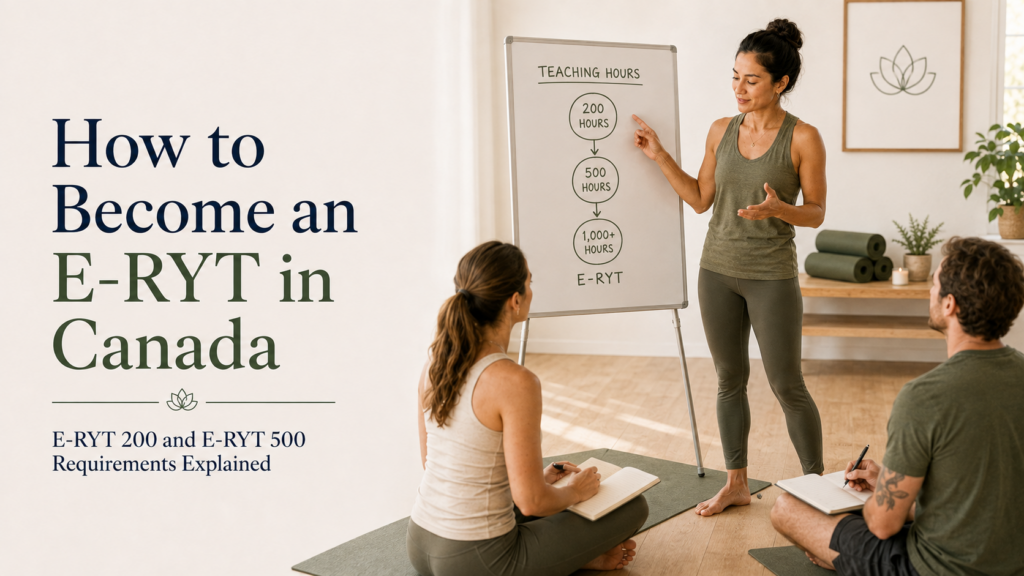
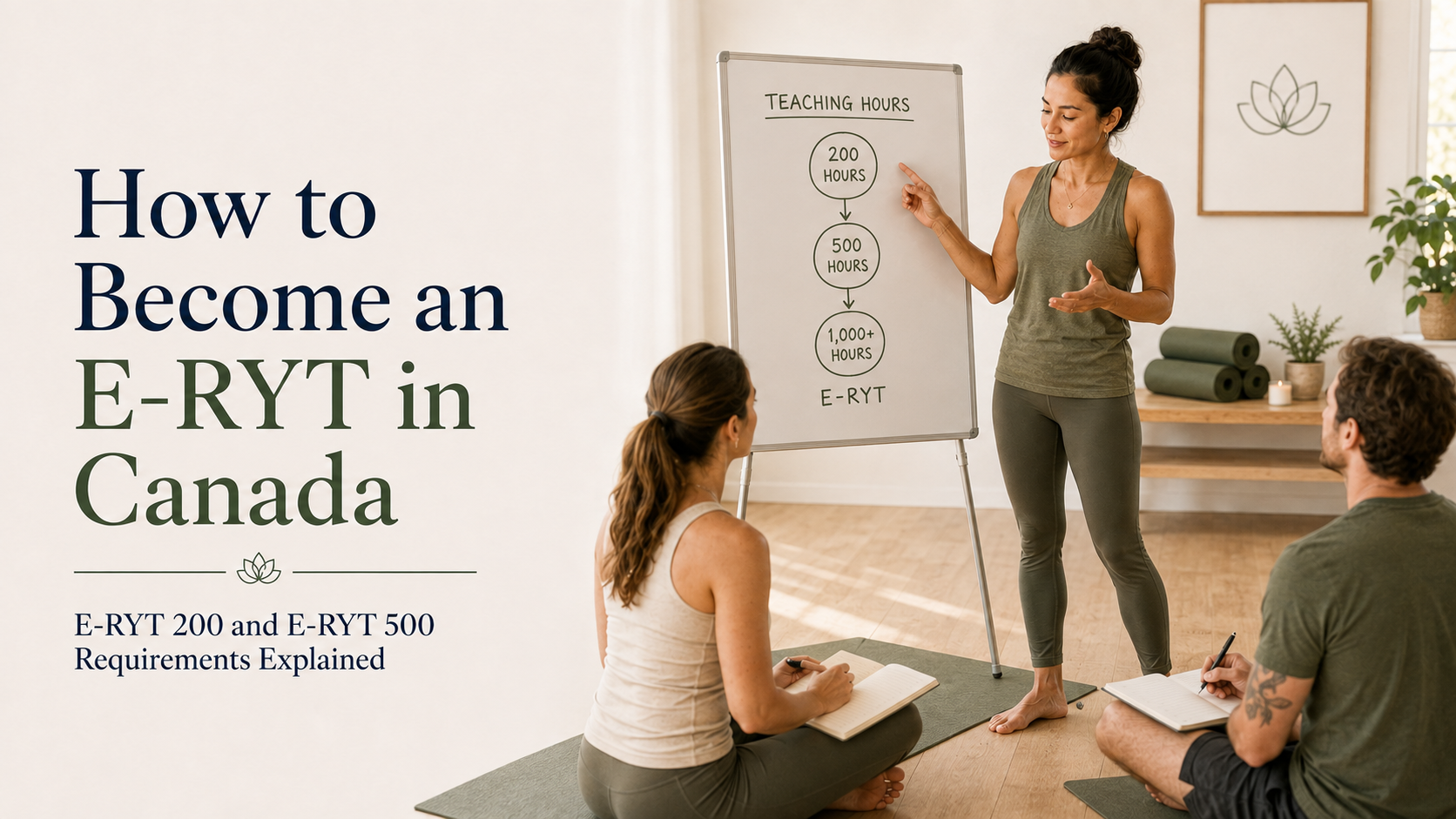
 How to Become an E-RYT in Canada: E-RYT 200 and E-RYT 500 Requirements Explained
You finished your teacher training. You’ve been teaching classes for a while now. And you keep seeing those extra letters next to other instructors’ names: E-RYT 200, E-RYT 500. What do they mean, and how do you get there yourself?
This guide, How to Become an E-RYT in Canada: E-RYT 200 and E-RYT 500 Requirements Explained, walks you through exactly what an E-RYT credential is, what each level requires, and how the process works for teachers based in Canada. Canada has no government license for yoga instruction. That means your credentials come from private registries, not the state. We’ll cover the major ones, compare your registration options, and show you the exact path from RYT to E-RYT status.
By the end, you’ll know whether you qualify now, how many hours and years you still need, and which registry fits your teaching goals.
What Does E-RYT Actually Mean?
E-RYT stands for Experienced Registered Yoga Teacher. The “E” is the whole story here. It tells studios, students, and other teachers that you didn’t just complete a training program. You’ve logged real hours in front of real students, over a meaningful stretch of time.
A standard RYT credential confirms training. You finished a 200-hour or 500-hour program at a registered school, and the registry verified your certificate. That’s it. It says nothing about how much you’ve actually taught.
An E-RYT credential adds a second layer: teaching experience. Registries set minimum thresholds for hours taught and years passed since your initial certification. You can’t apply for E-RYT status the day after graduation. You need time in the classroom first.
This distinction matters more than it might seem. Studios hiring for senior roles often ask for E-RYT status specifically. Yoga Alliance Continuing Education Providers (YACEPs), who run workshops and specialty trainings for other teachers, typically need an E-RYT designation to qualify. And if you eventually want to lead your own 200-hour teacher training program, most registries require you to hold an E-RYT 500 credential first. In short, E-RYT status is the credential that opens the door to mentoring, training, and leading — not just teaching a weekly class.
RYT vs. E-RYT: Why the Difference Matters
It helps to separate these two ideas clearly before going further, because the terminology trips up a lot of new teachers.
RYT (Registered Yoga Teacher) confirms that you completed a training program of a specific length — usually 200 or 500 hours — at a school registered with a recognized alliance. The registry checked your certificate, confirmed the school’s accreditation, and added your name to a public directory. That’s the entire process. No teaching experience is required to hold an RYT credential.
E-RYT (Experienced Registered Yoga Teacher) builds on that. You still need the underlying RYT credential. But you also need to prove you’ve taught a minimum number of hours, over a minimum number of years, since earning that first certification. Different registries set slightly different thresholds, which we’ll break down below.
Here’s a simple way to think about it: RYT tells people what training you completed. E-RYT tells people how much you’ve actually practiced the craft of teaching since then. A new instructor with excellent training can hold an RYT 200. Only time and consistent teaching turn that into an E-RYT 200.
This is also why E-RYT status can’t be bought or fast-tracked. Registries verify hours through class logs, studio letters, or self-reported records depending on the organization. It’s a credential built entirely on your teaching history, which is exactly why studios and training programs treat it as a meaningful signal of experience.
E-RYT 200 Requirements Explained
The E-RYT 200 is the first experienced-teacher tier, and it’s the one most working yoga teachers pursue first. Requirements are consistent across most major registries, with only small variations in verification process.
To qualify for E-RYT 200 through Yoga Alliance, the largest and most internationally recognized registry, you generally need:
- A completed RYT 200 certification from a Registered Yoga School (RYS 200).
- A minimum of 1,000 hours of teaching experience, accumulated after you earned your RYT 200.
- At least two years of teaching experience since completing that initial certification.
Those two thresholds — 1,000 hours and two years — work together. You can’t meet the hour requirement in six months by teaching back-to-back classes every single day. The two-year clock has to pass regardless of how many hours you log.
The Canadian Yoga Alliance (CYA) uses a very similar structure for its CYA-E-RYT 200 designation: roughly two years of teaching experience and 1,000-plus teaching hours since your original certification. CYA doesn’t require your foundational training to have come from a CYA-registered school, which gives Canadian teachers some flexibility if they trained elsewhere.
Yoga Alliance International publishes its own standards for E-RYT 200 as well, with defined training pathways and a grandfathering process for teachers who have substantial experience but may not hold formal documentation from a registered school.
Across all three, the underlying logic is the same: complete your 200-hour training, keep teaching consistently, and document your hours as you go. Save your class rosters, studio schedules, or a simple teaching log from day one. You’ll need that record when you apply.
 E-RYT 500 Requirements Explained
The E-RYT 500 sits at a higher tier, and it typically qualifies you to lead 200-hour teacher trainings, serve as faculty for other programs, and offer continuing education courses to fellow teachers. The requirements reflect that added responsibility.
Under Yoga Alliance standards, E-RYT 500 generally requires:
- A completed RYT 500 certification, either through a single 500-hour program or a 200-hour foundation plus a 300-hour advanced training.
- A minimum of 2,000 hours of teaching experience, with at least 1,500 of those hours completed after your original RYT 200.
- At least four years of teaching experience since your first certification.
That 1,500-hour detail matters. Yoga Alliance doesn’t just want 2,000 hours logged anywhere in your career. Most of it has to come after your foundational RYT 200, which means the clock effectively starts from your very first credential, not your 500-hour training.
Yoga Alliance International sets a comparable bar: applicants generally need at least 2,000 hours of teaching and four years of experience following their training. Notably, this registry also offers an alternative path — teachers who don’t meet the hours or years threshold can sometimes complete a competency exam instead, which is a useful option for instructors who trained intensively but haven’t logged years of part-time teaching.
The Canadian Yoga Alliance doesn’t publish as detailed a public breakdown for its 500-hour experienced tier, so if that’s your target registry, it’s worth confirming current thresholds directly with CYA before you apply.
Whichever registry you choose, the E-RYT 500 is a genuine milestone. It usually takes years of consistent teaching to reach, and it signals that you’re ready to train and mentor other teachers, not just lead your own classes.
Why Canada’s Credentialing Landscape Works Differently
Here’s something that surprises a lot of new teachers: Canada does not license yoga instructors. There’s no provincial exam, no government body, and no legal requirement to hold any credential at all before you teach a class. You can legally teach yoga in Canada without an RYT of any kind.
So why do credentials matter? Because studios, gyms, community centers, and insurance providers set their own hiring standards, and most of them look for a recognized registration. In practice, that makes private registries the de facto standard, even though none of them carry legal weight.
This creates a layered system. A “certification” is something a school gives you after you finish training and pass its internal assessments. “Registration” is a separate step — a membership status with a registry, where your name appears in a public directory alongside your training hours and credential level. You can hold a certification without ever registering with any alliance. Many teachers do exactly that, especially those teaching casually or at community studios that don’t require formal registration.
But if you want to work across multiple studios, get liability insurance through a yoga-specific provider, or eventually lead your own teacher training, registration becomes far more than a formality. Insurance providers in particular often ask directly for your RYT or E-RYT status before issuing a policy. So while nothing forces you to register, most professional paths in Canada run through one of these private registries sooner or later.
Comparing Your Registration Options in Canada
Canadian teachers generally choose between three organizations when it comes to registering their credentials. Each has a different history, geographic focus, and process, so it’s worth understanding what sets them apart before you commit your time and application fee.
Yoga Alliance (USA) is the largest and most internationally recognized registry in the world. Because so many studios and training programs default to its terminology — RYT 200, RYT 500, E-RYT — it’s often the safest choice if you plan to teach internationally or market yourself to students unfamiliar with Canadian-specific credentials. Registration requires proof of training from a registered school, an annual membership fee, and agreement to its published ethical standards.
Canadian Yoga Alliance offers a Canada-specific alternative with a national focus. Its membership benefits include insurance options tailored to Canadian law, including temporary coverage for retreats held overseas. If most of your teaching happens within Canada, and you value a registry built specifically around Canadian studios and Canadian teachers, this option carries strong local recognition. CYA also allows more flexibility around where your original training came from, which can help teachers who trained through smaller or independently accredited schools.
Yoga Alliance International provides another registration path, with its own published RYS and RYT standards, structured continuing education requirements, and a grandfathering pathway for teachers with substantial real-world experience but incomplete documentation from a registered school. It reviews training certificates against its own published criteria, similar to how the other two registries operate.
None of these three organizations is legally required. Some Canadian teachers register with more than one, especially if they teach internationally and locally, or if they want the insurance benefits of one alongside the global recognition of another. Before you choose, think about where you plan to teach, whether you’ll eventually lead trainings, and what your target studios or employers actually ask for. Reading a studio’s job postings or reaching out directly is often the fastest way to find out which registration actually matters in your market.
How to Apply for Your E-RYT Credential: Step by Step
Once you’ve met the hour and year thresholds for your target credential, the application process itself is fairly straightforward. Here’s the general path across most registries.
Confirm your foundational RYT is active. Before applying for E-RYT status, your base RYT 200 or RYT 500 registration needs to be current. If it lapsed, you’ll typically need to renew it first.
Gather your teaching hour documentation. This is the step teachers underestimate. You’ll need a record showing when and how much you taught since your certification date. Studio schedules, class rosters, letters from employers, or a personal teaching log all work, depending on the registry’s specific requirements. Start this habit early in your teaching career, even before you’re thinking about E-RYT status.
Submit your application with supporting evidence. Most registries process this online. You’ll list your training school, certification date, and total teaching hours, then upload or reference your supporting documentation.
Pay the applicable fee. Registries charge an application fee and annual membership dues. Yoga Alliance’s current combined first-year cost, for example, runs around $115 USD between the one-time application fee and annual dues.
Sign the registry’s ethical commitment. Most organizations require you to formally agree to their code of conduct and teaching ethics as part of registration.
Maintain your status with continuing education. E-RYT credentials aren’t permanent once granted. Most registries require ongoing continuing education hours — commonly around 30 hours every three years — to keep your registration active.
Set a calendar reminder for your renewal date. Letting your credential lapse means re-verifying everything from scratch, which is far more work than a simple annual renewal.
 What an E-RYT Credential Actually Lets You Do
It’s worth being specific about what changes once you hold E-RYT status, because the benefits go beyond a nicer title on your business card.
An E-RYT 200 typically qualifies you to serve as an assistant or supporting faculty member for 200-hour teacher training programs, depending on the school. It also strengthens your application when applying to teach at studios that specifically list experienced-teacher preference in their job postings.
An E-RYT 500 carries more weight. Most registries require this credential — or an equivalent — before you can serve as lead trainer for a 200-hour teacher training program. If you eventually want to open your own registered yoga school, this is usually the credential that makes that possible. It also typically unlocks Yoga Alliance Continuing Education Provider (YACEP) status, letting you offer accredited continuing education workshops and courses to other registered teachers.
Beyond the formal permissions, E-RYT status functions as a trust signal. Students researching teacher trainings, studios hiring for senior positions, and other teachers considering a mentor all use these letters as a quick way to gauge experience. It won’t replace strong teaching skills or good reviews, but it does open doors that a foundational RYT alone typically doesn’t.
Common Mistakes Teachers Make When Pursuing E-RYT Status
A few patterns show up again and again among teachers working toward E-RYT credentials, and avoiding them saves real time.
Not tracking hours from day one. The single biggest mistake is waiting until you’re close to qualifying before starting to document your teaching hours. Reconstructing years of class history from memory is difficult and sometimes impossible. Start a simple spreadsheet the day you begin teaching, even if E-RYT status feels far away.
Assuming certification and registration are the same thing. Some teachers complete their training, receive a certificate from their school, and assume they’re automatically registered with an alliance. Registration is a separate step you have to initiate yourself, with its own fees and paperwork.
Registering with the wrong organization for their goals. A teacher planning to lead international retreats has different priorities than one building a local studio career. Research where your target employers or students actually look before choosing a registry.
Letting registration lapse. Missing a renewal deadline, even briefly, can complicate your record when you eventually apply for E-RYT status. Keep your membership current throughout your teaching years, not just when you need it for an application.
Underestimating the time commitment. Even with intensive teaching, the two-year minimum for E-RYT 200 and four-year minimum for E-RYT 500 can’t be shortened. Plan your career timeline with that reality in mind rather than treating E-RYT as something you can rush.
 Frequently Asked Questions
Can I skip RYT 200 and go straight to E-RYT 500? No. Every registry requires the underlying RYT credential first. You need a completed RYT 200 (or RYT 500) before any experience-based application will be considered. There’s no way to bypass the foundational training requirement, regardless of how much informal teaching experience you have.
Do my teaching hours have to come from studio classes? Not necessarily. Most registries accept a range of teaching formats toward your hour total, including private sessions, online classes, workshops, and sometimes assisting in a teacher training program. Volunteer teaching often counts too, though the exact rules vary by registry, so check the specific standards page for whichever organization you’re applying to.
What happens if I switch registries partway through my career? You’ll generally need to submit your original training certificate and teaching records to the new registry, since each one verifies credentials independently. Many teachers hold registration with more than one organization at the same time rather than switching entirely, which avoids re-proving hours you already documented elsewhere.
Is E-RYT status required to teach yoga in Canada? No. Since Canada doesn’t license yoga teachers, nothing legally requires any credential at all. E-RYT status matters for career reasons — hiring preferences, insurance, and the ability to lead trainings — not legal ones.
How long does the application process usually take? Once you’ve met the hour and year requirements and gathered your documentation, most applications are processed within a few weeks. The real time investment is in the years of teaching that come before you’re eligible to apply, not the paperwork itself.
Conclusion: Your Path to E-RYT in Canada
Understanding how to become an E-RYT in Canada comes down to two things: completing your foundational RYT training, and then putting in real, documented hours of teaching over a meaningful stretch of time. E-RYT 200 generally asks for 1,000 teaching hours and two years since your RYT 200. E-RYT 500 raises that bar to roughly 2,000 hours and four years, built on a completed RYT 500. Because Canada has no government license for yoga teachers, your credential comes from a private registry — Yoga Alliance, the Canadian Yoga Alliance, or Yoga Alliance International — and the right choice depends on where and how you plan to teach.
The main takeaway is simple: there’s no shortcut to E-RYT status. It’s earned through consistent teaching, careful documentation, and time. Start logging your hours now, choose the registry that matches your teaching goals, and the credential will follow naturally as your experience builds.
If you’re ready to register, check out our Standards pages for RYT 200, E-RYT 200, and E-RYT 500 to see exactly what you need.