 Restorative Yoga Teacher Certification in Canada: Training Requirements, Credentials & How to Register (2026)
Restorative yoga teaches people to slow down. Students lie on bolsters and blankets. They hold gentle shapes for several minutes. A good teacher makes this look simple. The skill behind it is not.
If you want to teach this style in Canada, you probably have questions. Do you need a licence? How many training hours do you need? Which credential will studios and students trust? This guide, Restorative Yoga Teacher Certification in Canada: Training Requirements, Credentials & How to Register (2026), answers those questions in plain language.
You will learn what the law requires and what the industry expects. You will also compare three registration options. Fees and standards change, so confirm current details with each organization before you pay.
What Restorative Yoga Is and Who Teaches It
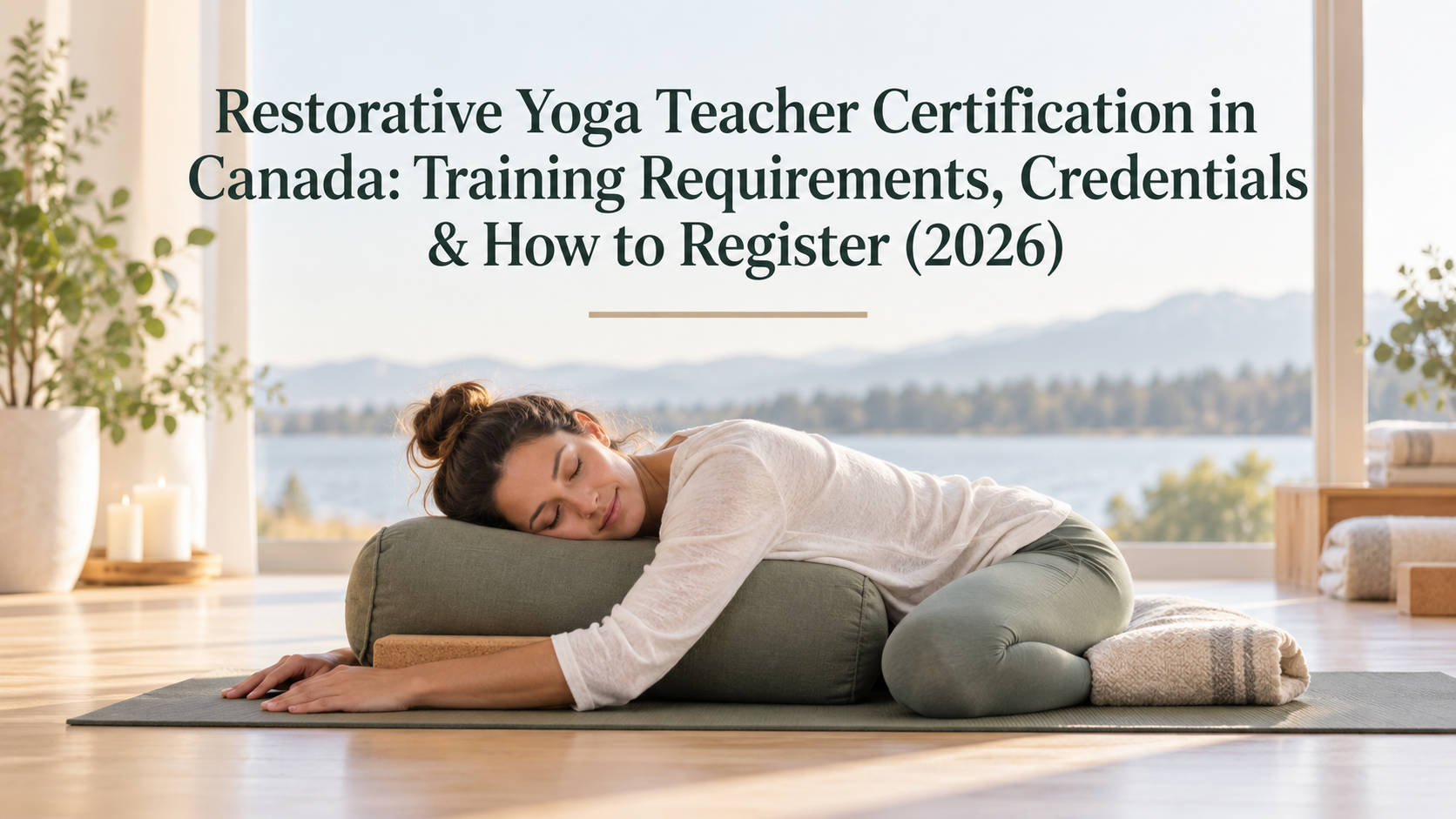
Restorative yoga is a slow, prop-supported practice. Students hold poses for long periods, often five to twenty minutes. Bolsters, blankets, and blocks carry the body’s weight. The muscles can then release. The goal is deep rest, not stretching or strength.
The style grew from the use of props in Iyengar yoga. American teacher and physical therapist Judith Hanson Lasater later shaped the modern form. Her book Relax and Renew introduced restorative yoga to a wide audience. You can read more about her work on her official website.
Restorative classes serve many people. Busy professionals attend them. So do people who feel overwhelmed by faster classes, athletes who need recovery time, and students returning to movement after a hard season. Some teachers work in studios. Others teach in wellness centres, workplaces, and retreat settings.
This variety shapes what you need to know. A restorative teacher must understand props, positioning, and pacing. You must also read the room. A student who looks relaxed might feel anxious. A student who looks restless might simply be uncomfortable. Training helps you notice the difference.
Restorative yoga is not a medical treatment. Research suggests yoga may help with stress and some types of pain, but results vary by person. The U.S. National Center for Complementary and Integrative Health summarizes the evidence in its yoga overview. Teachers should never promise medical outcomes. You teach a practice. You do not treat disease.
Is Certification Legally Required in Canada?
No. Canada does not license yoga teachers. No federal, provincial, or territorial government requires a yoga teaching licence. You can legally lead a class without a certificate.
That freedom does not make certification optional in practice. Most studios and gyms expect recognized training. Insurers often ask for proof of training before they cover you. Students also look for credentials, especially in a style that involves props, positioning, and vulnerable postures.
Rules for training schools vary by province. Some provinces regulate private career colleges. Whether a yoga teacher training falls under those rules depends on the school’s structure and local law. Ask any school a direct question: “Are you regulated or exempt in my province, and how do refunds work?” A professional school will answer clearly.
Because the law leaves the field open, the industry sets its own standards. Private registries define training hours, curriculum areas, and teacher requirements. The most common benchmark is the 200-hour training.
Think of certification as a trust signal. It tells studios, insurers, and students that you completed structured education. It does not make you an expert on day one. It shows you started on solid ground.
The key point is simple. Canadian law does not require you to certify, but the market does. Plan to complete recognized training and register with a credible organization.
The Foundation: A 200-Hour Teacher Training
Most restorative teachers begin with a general 200-hour yoga teacher training. This course covers the full practice, not one style. It is the standard entry credential in Canada and around the world.
A well-designed 200-hour program covers several areas. Students study yoga techniques and practice. They learn teaching methodology, including sequencing and cueing. They study anatomy and physiology. They explore yoga philosophy, ethics, and history. They also learn professional skills and complete practice teaching.
Registries publish their own standards for this level. The RYT-200 standards at Yoga Alliance International show how one registry defines the credential, including training and teaching requirements.
Why start with 200 hours? Restorative yoga looks easy, but it rests on the same foundations as every other style. You must understand alignment, anatomy, and safe cueing. You must also know how to guide a group. A teacher who skips this foundation may struggle to adapt poses for different bodies.
Some people take a restorative course without a 200-hour base. That path is possible. Many studios will hire you only if you also hold a general certification, though. A 200-hour training opens more doors.
Training comes in several formats, including in-person, online, and hybrid. Each can work. A later section explains how to choose.
Restorative Specialty Training: What to Look For
After your 200-hour training, you can add restorative-specific education. This is where you learn the craft of the style. Specialty programs range from a weekend to several weeks. Many run between 10 and 50 hours, and some are longer.
Be careful with one point. A restorative course is usually additional training, not a standalone teaching credential. In most cases it builds on a 200-hour certificate. Registries treat specialty hours differently, so check how your chosen registry counts them before you enrol.
A strong restorative program teaches you to do the following:
- Set up props so a student feels fully supported
- Adjust poses for different body sizes, ages, and abilities
- Sequence a class for a calm, steady descent into rest
- Use your voice and silence with care
- Recognize when a student needs a different approach
Look for teachers with real experience. Ask who leads the course and how long they have taught restorative yoga. Ask about class size and supervised practice time. You learn this style by doing it, so hands-on hours matter.
Check for transparency, too. A trustworthy program tells you where its methods come from. It also explains its limits. If a course promises to make you a “healer” or teach you to treat medical conditions, walk away. Yoga teachers work within a defined scope. Our guide to yoga teacher scope of practice in Canada explains where those boundaries sit.
Many teachers also study a related slow style. If you want to teach both, read our breakdown of whether you need certification to teach yin yoga in Canada. The two styles share a quiet mood but differ in purpose. Yin targets connective tissue with longer holds. Restorative aims for rest and relaxation.
 What a Restorative Curriculum Should Cover
A complete restorative curriculum goes beyond lying on a bolster. It blends practical skill with sound knowledge. Here are the main areas to expect.
Props and setup. You will learn how to use bolsters, blankets, blocks, straps, chairs, and eye pillows. You will practise building poses from scratch. Small changes matter. A blanket folded two inches higher can change how a student feels.
The physiology of rest. Good programs explain how slow breathing and stillness affect the body. They keep the science simple and honest. You can say that restorative practice often helps people feel calmer. You should not claim it cures anxiety or any other condition.
Safety and contraindications. This section protects your students. You will study when to modify or skip certain poses. Pregnancy, high blood pressure, glaucoma, reflux, back pain, and recent surgery all call for care. You will learn when to ask a student to check with their healthcare provider.
Teaching skills. You will practise cueing, pacing, and timing. Restorative classes use fewer words than active classes. Silence becomes a tool. You will learn how to guide students into a pose and then step back.
Class design. You will build sequences for different goals, such as an evening wind-down, stress recovery, or gentle practice for older adults. You will also plan classes of different lengths.
Ethics and inclusion. Students in restorative classes often feel vulnerable. You will study consent, touch, trauma-aware language, and respectful communication. Many programs also cover how to welcome people of all bodies and backgrounds.
Ask any program for a written outline. If you cannot see what you will learn, treat that as a warning sign.
Choosing a Program: Online, In-Person, or Hybrid
Canada is large, and training access varies. A teacher in Victoria has different options than one in a small northern town. Online programs have widened choices for everyone. Each format has strengths.
In-person training gives you hands-on practice with props and real bodies. You can adjust a partner’s pose and receive feedback in the moment. You also build relationships with teachers and peers. The tradeoff is cost and travel.
Online training offers flexibility and often a lower price. You can study from home and revisit recordings. Live sessions add interaction. The tradeoff is less physical feedback. Restorative yoga depends on prop placement, so look for programs that require video practice teaching with feedback.
Hybrid training combines both. You study theory online and attend short in-person sessions for practice. For many working adults, this is a practical middle path.
Registries treat online training differently. If you plan to register, read our explanation of whether you can register as an RYT-200 after online yoga teacher training before you commit.
Whatever format you choose, verify these points before you pay:
- The school’s registry status is real. Our guide on how to check if a yoga school is registered shows how.
- The lead instructors have clear, verifiable experience.
- The schedule gives you enough practice teaching time.
- The refund and cancellation policy is in writing.
- Former students can describe their experience honestly.
Be cautious about programs that promise certification in a few days. Quality training takes time. A 200-hour course usually spans several weeks or months, even in intensive formats.
Finally, consider your own learning style. Some people thrive in a group. Others prefer to work alone. Pick the format you will finish.
How to Register as a Yoga Teacher in Canada: Three Options Compared
Registration is separate from training. Training gives you knowledge. Registration lists you with an organization that sets professional standards. You complete your course first. Then you apply.
Canada has no government registry. You have three main private options. Each works differently, so compare them carefully. Our overview of how to register as an RYT-200 yoga teacher in Canada covers documents and fees in more detail.
One point applies to all three. None of them lists a dedicated restorative designation on its public standards pages. Yoga Alliance’s specialty credentials, for example, cover areas like prenatal and children’s yoga. You register at the general teacher level. You then record your restorative training as additional education.
Option 1: Yoga Alliance (USA)
Yoga Alliance is the largest yoga registry in the world. It is based in the United States and registers teachers and schools internationally, including in Canada. Its best-known designation is the RYT-200, which stands for Registered Yoga Teacher. Teachers usually qualify by completing a 200-hour program at a Registered Yoga School. Higher levels include the RYT-500.
Brand recognition is its main advantage. Many studios and insurers know the RYT title. The tradeoff is that your training generally must come from a Yoga Alliance Registered Yoga School. Check the current rules and fee schedule on its website before you apply.
Option 2: Canadian Yoga Alliance
The Canadian Yoga Alliance is a national registry that has operated since 2002. Its membership designations page lists every level. A CYA-RYT 200 requires 200 hours of training from one school and a teacher certificate. Your training does not have to come from a CYA-registered school. No teaching hours are required to register at this level.
At the time of writing, the page lists the CYA-RYT 200 at $109 with a $99 renewal. It also offers a 30 percent discount if you trained at a CYA-registered school. Fees change, so confirm them before you apply. The CYA also offers insurance through a partner, which may appeal to teachers who want one place for registration and coverage.
Option 3: Yoga Alliance International
Yoga Alliance International accepts several training routes for its RYT-200. You can qualify with a 200-hour program registered with Yoga Alliance International. You can also qualify with a 200-hour program from a recognized yoga organization, online or in person. Its standards list Yoga Alliance (USA) and the Canadian Yoga Alliance among those organizations. A third route covers equivalent training or substantial teaching experience through grandfathering.
No teaching hours are required at the RYT-200 level. The application is free to submit. The team reviews it, and you receive a payment link only after approval. To stay active, you follow the code of conduct and pay an annual renewal. You can see current pricing on the fees page.
How to Choose
Ask yourself three questions. Which credential do studios in your area recognize? Which fits your training history and budget? Which organization supports your long-term plans, such as teaching abroad?
You do not have to choose only one for life. Some teachers hold more than one registration. Costs and renewal duties add up, though, so choose with care.
 Costs, Insurance, and Taxes for Canadian Teachers
Planning your budget early prevents surprises. Expect several categories of cost.
Training tuition. A 200-hour program in Canada varies widely in price based on format, location, and school. Restorative specialty courses usually cost less but still add up. Ask for a full fee breakdown. Find out whether books, props, and manuals are included.
Registration fees. Registries typically charge an application or registration fee plus an annual renewal. Amounts change, so check each registry’s current fee schedule. Do not rely on old articles for pricing, including this one.
Props. Restorative classes need quality props. Bolsters, blankets, blocks, and straps are the basics. Some studios supply props. If you teach privately or in community spaces, you may need your own set.
Liability insurance. Insurance protects you if a student reports an injury. Many studios require it. Insurers often ask about your training and registration. Talk to a provider that covers fitness or wellness professionals in Canada, and confirm exactly what your policy covers.
Taxes. If you earn income from teaching, you must report it. Self-employed teachers should keep clear records of income and expenses. You generally must register for GST/HST once your taxable revenues exceed $30,000 in a single calendar quarter or over four consecutive calendar quarters. The Canada Revenue Agency explains the rules on its page about when to register for and start charging the GST/HST. Consider speaking with an accountant, since provincial rules differ.
Treat these costs as an investment in your career. Compare programs on value, not only on price. A cheap course that no registry recognizes can cost you more in the end.
Continuing Education and Building Credibility
Certification marks the start of your learning. The best restorative teachers keep studying. They also keep practising.
Registries ask teachers to stay engaged to keep their listing active. The details differ by organization, so review your registry’s current requirements. Yoga Alliance International publishes its continuing education provider standards, which show how providers qualify to offer post-certification training.
You can build your knowledge in several ways. Take advanced restorative workshops. Study anatomy more deeply. Learn about trauma-aware teaching. Attend retreats with experienced teachers.
Credibility also grows from experience. Teach regularly. Ask students for feedback. Record yourself and review your cueing. Find a mentor who will watch your classes and tell you the truth.
Be honest about your scope. Say “I teach restorative yoga” rather than “I heal back pain.” Refer students to healthcare professionals when their needs go beyond yoga. This honesty builds trust, and trust is the heart of a teaching career.
When you are ready to advance, consider the next level. The RYT-500 standards show how additional training builds on a 200-hour certificate.
A Step-by-Step Plan to Get Started
Here is a clear path you can follow from today.
Step 1: Practise first. Attend restorative classes regularly. Learn how the style feels as a student. Note what great teachers do.
Step 2: Choose a 200-hour training. Pick a program that meets recognized standards. Check the curriculum, the teachers, and the registry status.
Step 3: Complete your training. Attend every session and finish your practice teaching. Keep your certificate and any hour logs.
Step 4: Add restorative specialty training. Choose a program led by experienced teachers. Confirm how your registry counts the hours.
Step 5: Pick a registry. Compare Yoga Alliance, the Canadian Yoga Alliance, and Yoga Alliance International. Choose the one that fits your goals.
Step 6: Register. Gather your documents. Complete the application and pay the fee.
Step 7: Get insured. Secure liability coverage before you teach publicly.
Step 8: Start teaching. Begin with friends, community classes, or studio assistant roles. Build confidence before you take on large groups.
Step 9: Keep learning. Track your continuing education. Renew your registration on time.
Most teachers need several months to complete the first six steps. Do not rush. A careful start pays off for years.
Conclusion
Restorative Yoga Teacher Certification in Canada: Training Requirements, Credentials & How to Register (2026) comes down to one clear message. Canadian law does not require a yoga teaching licence, but studios, insurers, and students expect recognized training. The strongest path begins with a 200-hour teacher training. You then add restorative-specific education and register with a credible organization.
You have three registration options: Yoga Alliance (USA), the Canadian Yoga Alliance, and Yoga Alliance International. Compare their standards, costs, and recognition before you decide. Plan for insurance, taxes, and continuing education as well. Keep your teaching honest and within your scope.
If you’re ready to register, check out our RYT-200 standards to see exactly what we require and how to apply.