 Does Yoga Teacher Training Expire? How to Register Years Later in Canada (2026 Guide)
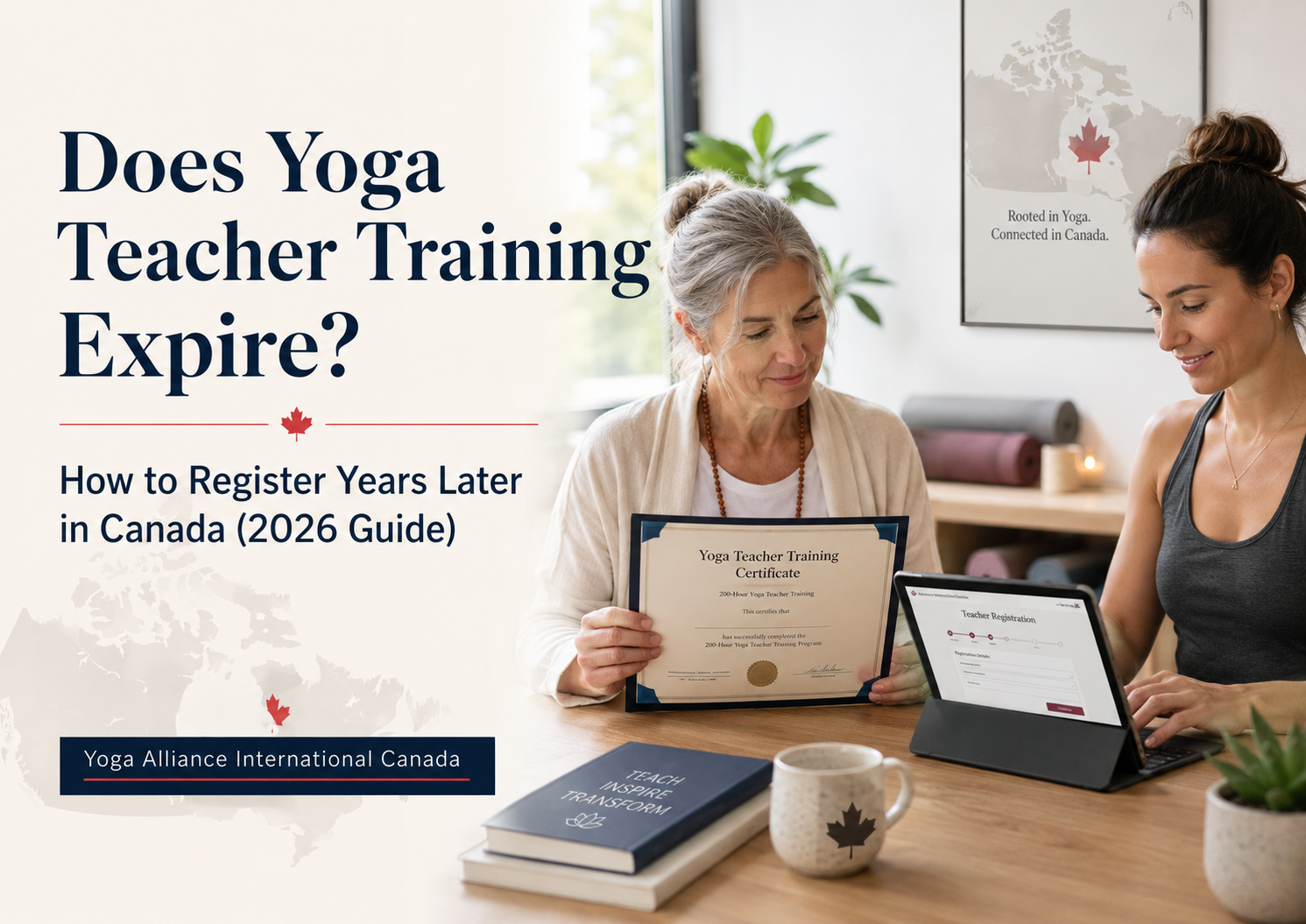
You finished your 200-hour yoga teacher training. Then life happened. A few years passed, and you never registered with an alliance. Now you’re wondering if your certificate is still good, or if you missed some invisible deadline.
Here’s the short answer: your training does not expire. But there’s more to the story, especially if you’re teaching (or want to teach) in Canada. Yoga credentialing involves overlapping terms, several different registries, and rules that vary depending on which organization you choose. That’s a lot to untangle when all you really want to know is whether your certificate is still good and what to do next.
This guide walks through what actually happens to your certification over time, whether you need to register at all, and exactly how to do it years after graduation. It also compares the three main registration paths available to Canadian teachers today, so you can make an informed choice instead of guessing.
Does Yoga Teacher Training Actually Expire?
No. A completed yoga teacher training certificate has no expiration date. Once a school issues it, it stays valid indefinitely, whether that was six months ago or fifteen years ago. This holds true across every major registry, including Yoga Alliance in the United States, the Canadian Yoga Alliance, and Yoga Alliance International.
What can lapse is your registration status with one of these organizations, and that’s a completely different thing. Registration is a membership you maintain by paying annual dues. Your certificate is the proof of training you completed. One is a document. The other is a subscription.
This distinction confuses a lot of teachers, understandably. The terminology overlaps: certified, registered, RYT, RYS. But the underlying mechanics are simple once you separate them. Your training doesn’t decay. Your membership status can.
So if you trained in 2018 and never registered, your certificate today is exactly as valid as it was the day you received it. Nothing about the passage of time changes that. The only thing that has changed is your eligibility clock has kept running in a good way. There’s no penalty for waiting, and no re-testing requirement, as long as you still hold your original certificate.
 Certification vs. Registration: The Distinction That Matters
Understanding this one difference will save you hours of confusion.
Certification happens once. Your yoga school evaluates your practicum, your teaching hours, and your coursework. When you pass, they issue a certificate. This document belongs to you permanently. No organization can revoke a certificate that was properly earned, and no time limit attaches to it.
Registration is different. It’s an ongoing relationship with a governing body, like Yoga Alliance, the Canadian Yoga Alliance, or Yoga Alliance International. When you register, your name appears in a public directory. You typically pay an initial application fee, then renew annually. If you stop paying, your listing becomes inactive, but your underlying certificate remains untouched.
Think of it like a driver’s license versus a driving course. Once you pass driver’s ed, you always know how to drive. But your license (the credential that lets you legally operate on public roads) needs periodic renewal. Letting your license lapse doesn’t erase your driving skill. It just means you need to go through a renewal process before the license is valid again.
The same logic applies here. A yoga teacher whose registration lapsed for five years hasn’t lost their training. They’ve simply let a membership go inactive. Reactivating it, or registering for the first time years later, is usually a straightforward administrative process rather than a re-education requirement.
Why Teachers Wait Years to Register
It’s common. Many teachers complete training and never register right away, for a mix of practical reasons.
Some finish training with no immediate plans to teach publicly. They wanted the personal growth, not a teaching career, at least not yet. Others start teaching informally at a friend’s studio or a community class where nobody checks credentials. Registration fees also give people pause; paying annual dues for a credential you’re not actively using can feel unnecessary.
Then there’s the group who simply didn’t know registration was optional and separate from certification. They assumed their school automatically registered them, or they figured they’d deal with it “eventually” and years slipped by.
None of these reasons cause a problem later. Registries don’t penalize late registration. There’s no cutoff window, no expired-certificate fee, and no requirement to retake any part of your training. Whether you register one month or ten years after graduating, the process looks the same.
What Happens to Your Certificate If You Wait
Nothing happens to the certificate itself. Paper doesn’t age out. But a few practical issues can surface the longer you wait, and it helps to plan for them.
Your school might close or change ownership. If a registry needs to verify your certificate against a sample on file from your original school, and that school no longer exists, verification can take longer. Keep a physical or scanned copy of your original certificate in a safe place, ideally as soon as you receive it.
Contact information changes. If a registry needs to confirm your hours with your training provider, having up-to-date contact details for your former instructor helps speed things along.
Standards evolve. Registries periodically update their curriculum requirements for new schools. This doesn’t retroactively affect people who already trained under older standards. Your training is evaluated based on the standards in effect when you completed it, not the standards in effect the day you apply.
You may want to double-check your hours documentation. Some certificates list total hours without a detailed breakdown. If you plan to register years later, gather any supplementary materials, syllabi, transcripts, or hour logs your school provided, in case a registry asks for more detail.
None of these are dealbreakers. They’re simply reasons to keep good records rather than reasons to worry.
 Do You Even Need to Register?
This is worth asking honestly before you spend money on any registration fee.
Yoga is an unregulated industry in Canada and the United States. No government body licenses yoga teachers the way it licenses, say, physiotherapists or electricians. Technically, you can teach yoga without registering with any organization at all.
That said, several practical factors push most teachers toward registration eventually.
Insurance requirements. Many Canadian insurers require proof of a minimum training standard, often 200 hours from a recognized school, before issuing professional liability coverage. Some insurers accept registration with an alliance as that proof. If you plan to teach at a studio, gym, or community centre, you’ll almost certainly need liability insurance, and that insurance provider will want documentation.
Studio and employer requirements. Many studios, gyms, and corporate wellness programs won’t hire teachers without a verifiable credential. A registration listing gives them an easy way to confirm your training without asking you to mail in paperwork.
Client trust. Prospective students increasingly search for credentials before booking classes or private sessions. A recognized designation signals that you completed structured training and agreed to a code of conduct.
Opportunities abroad. If you ever want to teach internationally, retreat centers and studios outside Canada often specifically look for recognized registrations, since they can’t easily verify an unlisted certificate from an unfamiliar school.
If none of these apply to you right now, you can wait. Registration isn’t mandatory, and it isn’t going anywhere. But if you’re applying for insurance, pursuing studio work, or want your name discoverable by students searching online, registering is the practical next step.
It also helps to think about registration as a career decision rather than a legal one. Nobody is going to stop you from teaching without it. But over a multi-year teaching career, a registered credential tends to open more doors than it closes. It signals to studios, insurers, and students that you completed a recognized program and agreed to a professional code of conduct. For some teachers, that’s worth the annual fee. For others teaching casually among friends or in a single community setting, it may not matter much at all. There’s no universally right answer, only the answer that fits your specific teaching goals.
Comparing Your Registration Options in Canada
If you’ve decided to register, or reactivate a lapsed registration, you have three main choices in Canada. Each has a different focus, cost structure, and geographic reach. Here’s how they compare.
Yoga Alliance (United States)
Yoga Alliance is the largest and most internationally recognized yoga registry, headquartered in the United States. It created the trademarked title “Registered Yoga Teacher” (RYT) and maintains a global directory used by studios and retreat centers around the world.
To register, you need a certificate from a Registered Yoga School (RYS) that meets Yoga Alliance’s training standards. There’s no cutoff for how long ago you completed training. The initial cost is $115 USD: a one-time $50 application fee plus $65 in annual dues. After the first year, you pay $65 annually to stay active. Yoga Alliance also requires ongoing continuing education hours on a recurring cycle to maintain your registration, so budget time for that as well.
If you plan to teach abroad or want the most globally recognized designation, this is often the credential international employers look for first.
Canadian Yoga Alliance
The Canadian Yoga Alliance (CYA) is a national registry founded in 2002, based in Canada and focused specifically on the Canadian yoga community. It functions as a made-in-Canada alternative, with membership tiers, insurance partnerships, and continuing education programming built around Canadian teachers, studios, and schools.
CYA offers grandfathering options for long-time teachers without formal 200-hour certificates but with substantial teaching experience, which can be useful if you’ve been teaching informally for years without a training program behind you. Fees and renewal requirements vary depending on your designation and training hours, so it’s worth reviewing their current membership roster and fee schedule directly.
If your priority is a Canadian-based organization with local insurance partnerships and a community built around Canadian studios, CYA is worth strong consideration.
 Yoga Alliance International
Yoga Alliance International offers a global registry option that recognizes training completed through several pathways, including programs registered with Yoga Alliance (US), the Canadian Yoga Alliance, or the International Yoga Federation. It also offers a grandfathering process for experienced teachers without a formal 200-hour certificate.
One notable difference: Yoga Alliance International does not require mandatory continuing education to maintain your basic registration, though it does offer structured continuing education pathways for teachers who want to advance toward higher credential levels. This can appeal to teachers who want a recognized registration without an ongoing coursework obligation.
Since it accepts training from multiple existing organizations (including CYA and Yoga Alliance US), it’s a practical option if your original certificate came from a school affiliated with any of those bodies, and you want a registry with international reach but flexible maintenance requirements.
Step-by-Step: How to Register Years After Training
The process is nearly identical whether you finished training last month or a decade ago. Here’s the general path.
Step 1: Locate your original certificate. You’ll need the document your school issued, showing your name, training hours, program dates, and an authorized signature.
Step 2: Choose your registry. Decide between Yoga Alliance, Canadian Yoga Alliance, or Yoga Alliance International based on where you plan to teach and what credential holds the most weight for your goals.
Step 3: Create an account. Most registries require you to set up an online profile before submitting anything.
Step 4: Submit your certificate and training details. Upload your certificate, along with any supporting documentation the registry requests, such as a syllabus or hour breakdown.
Step 5: Pay the application and membership fees. Fees vary by organization, as outlined above. Expect a one-time application charge plus a recurring annual fee.
Step 6: Wait for verification. The registry compares your certificate against records from your training school. This step can take anywhere from a few days to a couple of weeks, depending on how easily your school’s records can be confirmed.
Step 7: Complete your listing. Once approved, your profile becomes active in the public directory, and you can list your credential publicly.
Step 8: Note your renewal date. Mark your calendar so you don’t accidentally let your new registration lapse the way your original certificate sat unregistered for years.
None of these steps require retraining, retesting, or justifying your delay. Registries are used to processing applications from people who trained years ago.
What If You Don’t Have Your Original Certificate?
This happens more often than you’d think, especially after several years. If your certificate is lost, damaged, or was never physically issued (some smaller schools were informal about paperwork), you have a few paths forward.
First, contact your original school directly. Many schools keep records and can reissue a certificate, sometimes for a small administrative fee. This is almost always the fastest solution.
If your school has closed, search for the lead trainer or program director individually. Teacher trainers often keep personal records even after a studio shuts down.
If neither option works, most registries have a process for teachers who can document their training through alternative means, like payment receipts, course materials, photos from the training, or written confirmation from fellow graduates. It’s more work, but it’s not a dead end.
Finally, some organizations offer grandfathering pathways for teachers with significant experience but incomplete documentation. Both the Canadian Yoga Alliance and Yoga Alliance International mention grandfathering options for exactly this kind of situation. If you’ve been teaching for years without formal registration and your paperwork trail is thin, this route is worth exploring before assuming you’re stuck.
 Keeping Your Registration Active After You Join
Once you register, whichever organization you choose, a little bit of upkeep keeps your listing current.
Pay attention to renewal dates. Most registries bill annually, and missing a payment can quietly move your status from active to inactive without much warning. Set a calendar reminder well before your renewal date arrives.
Check continuing education requirements. Some registries require a set number of hours over a recurring cycle, often structured across a two- or three-year period. Others, like Yoga Alliance International, don’t mandate continuing education for basic registration but offer it as an optional path toward advanced credentials. Know which category your chosen registry falls into so you’re not caught off guard.
Keep your contact and certificate records updated. If you move, change your email, or complete additional training, update your profile so your listing stays accurate.
Read the code of conduct you agreed to. Every major registry ties registration to an ethical commitment. Staying informed about what that includes protects your standing.
Common Mistakes to Avoid When Registering Late
A few avoidable errors trip up teachers registering years after training.
Assuming your certificate is invalid because time has passed. It isn’t. Don’t let years of delay convince you that you need to retrain.
Trying to combine multiple short courses into one 200-hour credential. Most registries require a single, complete 200-hour program from one school. Stacking together several shorter workshops usually won’t satisfy this requirement, even if the combined hours add up.
Losing track of your original school’s contact information. Reach out and confirm they still have your records before you need them urgently.
Registering with the wrong organization for your goals. If you plan to teach internationally, a Canada-only registry may not carry the same recognition abroad. If you plan to teach exclusively in Canada, a US-based registration might cost more than necessary for your needs. Match the registry to where you’ll actually use the credential.
Forgetting that registration and insurance are separate. Registering with an alliance doesn’t automatically give you liability insurance. You’ll typically need to arrange that separately, even after your registration is active.
Frequently Asked Questions
Can I register with Yoga Alliance ten years after finishing my training? Yes. There’s no cutoff period. As long as you have your original certificate or can otherwise document your training, you can apply at any time.
Do I lose my certification if I never register? No. Certification and registration are separate. An unregistered teacher is still fully certified; they just don’t appear in a public registry directory.
Which registry is best for teaching only in Canada? The Canadian Yoga Alliance is built specifically around the Canadian market, with local insurance partnerships and a Canada-focused community. Yoga Alliance International also accepts Canadian training and serves teachers across the country.
Do I need continuing education hours to register for the first time? No. Continuing education requirements apply to maintaining an active registration after you join, not to the initial application.
What if my training was less than 200 hours? Most standard RYT-200 registrations require a complete 200-hour program. If your training was shorter, look into whether your registry of choice offers other designations or grandfathering pathways based on teaching experience.
 Final Thoughts
So, does yoga teacher training expire? No, it doesn’t. Does Yoga Teacher Training Expire? How to Register Years Later in Canada comes down to one central idea: your certificate is permanent, but registration is a membership you can join at any point, even years after graduation.
If you trained a long time ago and never registered, nothing has been lost. Gather your certificate, decide which registry fits your teaching goals, whether that’s the international reach of Yoga Alliance, the Canada-specific focus of the Canadian Yoga Alliance, or the flexible, multi-pathway model of Yoga Alliance International, and apply whenever you’re ready. There’s no penalty for waiting, and no shortcut you missed.
If you’re ready to take that step, check out our RYT-200 Standards page to see exactly what’s required to register.