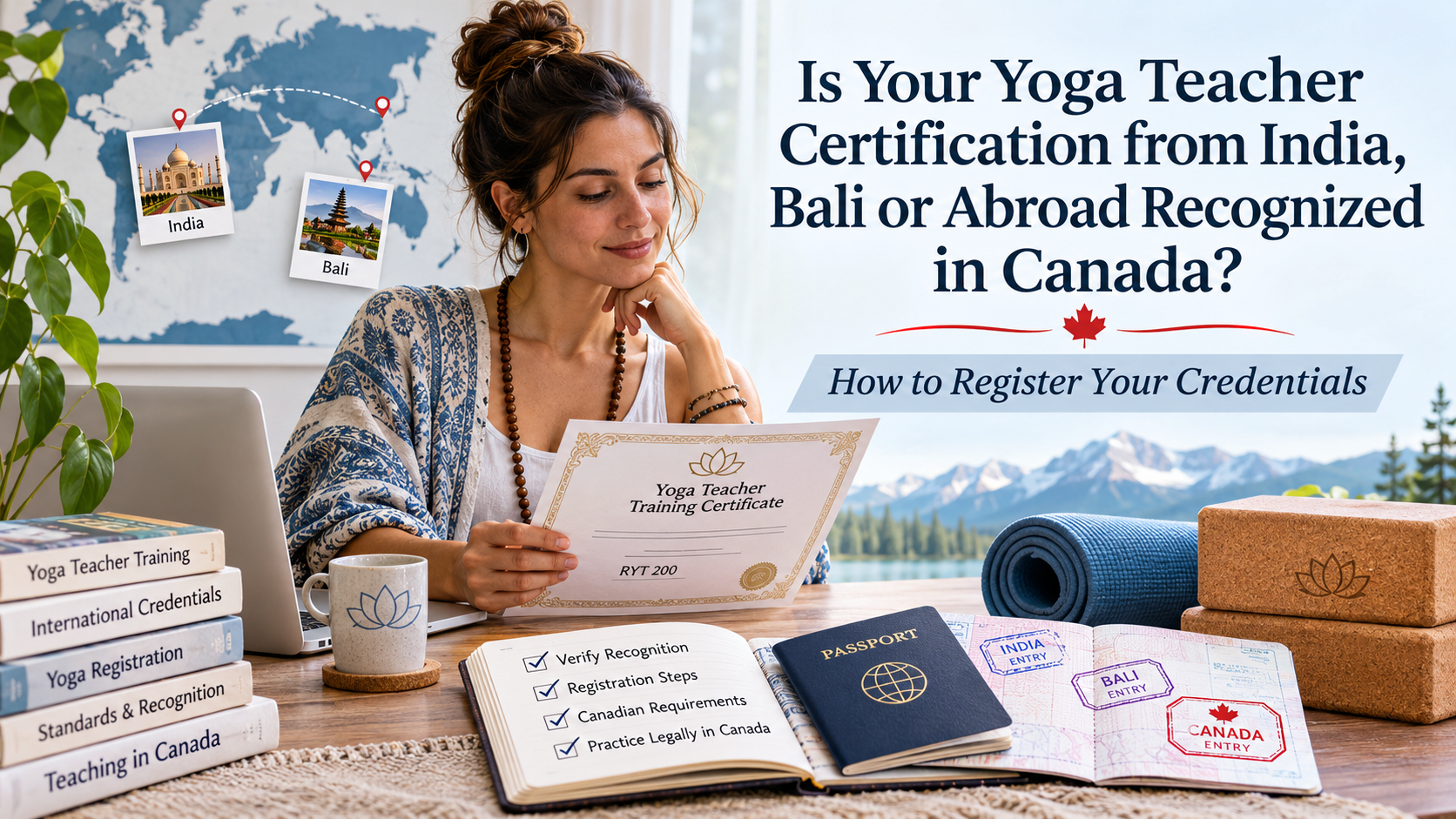
 Is Your Yoga Teacher Certification from India, Bali or Abroad Recognized in Canada? How to Register Your Credentials
You finished your training. Maybe you spent a month in Rishikesh, a few weeks in Ubud, or a summer in Thailand. You hold a certificate, a stack of notes, and a strong wish to teach. Then you moved home, or you plan to, and a practical question hits: is your yoga teacher certification from India, Bali or abroad recognized in Canada, and how do you register your credentials?
This guide answers that question in plain language. You will learn how yoga teaching works under Canadian law, what “recognized” means in practice, and why some certificates travel better than others. You will also see how three registries compare: Yoga Alliance (USA), the Canadian Yoga Alliance, and Yoga Alliance International. Finally, you will get a step-by-step plan to register.
Here is the short version. Canada does not license yoga teachers. Studios, gyms and insurers decide what they accept. A registry listing gives them an easy way to check your training. Your overseas certificate can still be the foundation of that listing.
Does Canada License Yoga Teachers?
No. Canada does not require a government licence to teach yoga. No federal body regulates yoga instruction. Provinces do not issue a “yoga teacher licence” either. You can legally teach a class without joining any organization.
That fact surprises many new teachers. They assume a national board approves every certificate. It does not. The Canadian Yoga Alliance has said publicly that groups like it are not legislatively empowered governing bodies. The same is true of every private yoga registry, in Canada or anywhere else.
So who decides whether your certificate “counts”? Four groups do, and they do it informally:
- Studio owners and managers. They set hiring rules for their own spaces.
- Gyms, community centres and corporate wellness programs. They often ask for proof of training and insurance.
- Insurance providers. They set eligibility rules for liability coverage.
- Students. Many people look for a credential before they book a class or training.
This system gives you flexibility. It also gives you responsibility. You must show that your training was real and that you teach safely. A recognized registry listing helps you do both.
One more point deserves attention. Even without a licence, you still follow the law. You must not claim to treat medical conditions unless you hold the right professional qualifications. You must also carry sensible insurance, follow your employer’s policies, and respect consumer protection rules in your province. Yoga teachers who market “therapy” without a healthcare background take on real risk. Keep your language clear: you teach yoga, you do not diagnose or treat disease.
What “Recognized” Really Means for Yoga Teachers
People use the word “recognized” loosely. It helps to break it into three layers.
Layer one: legal recognition. Canada does not offer this for yoga teachers, as explained above. No overseas certificate has legal standing, and no Canadian certificate has it either.
Layer two: registry recognition. A yoga registry reviews your training documents. If your training meets its standards, the registry lists you and lets you use its designation. Examples include RYT-200, which stands for Registered Yoga Teacher with a 200-hour foundation. This is the layer you can control.
Layer three: market recognition. This is the practical test. Will a studio hire you? Will an insurer cover you? Will students trust you? Market recognition depends on your training quality, your teaching skill, your registry listing, and the expectations of your local community. A Toronto boutique studio may ask for one thing. A community centre in rural Quebec may ask for another.
Because layers one and three are outside your control, layer two matters most. A registry listing turns a foreign certificate into something a Canadian hiring manager can verify in two minutes.
Notice what a registry cannot do. It cannot prove you are a great teacher. It cannot replace practice, mentorship or teaching experience. It confirms that you met a stated standard at a stated time. That is useful, and it is honest.
Why Your Overseas Training May Be Accepted, and When It Might Not
Training in India, Bali and other popular destinations is common. Thousands of Canadians complete a 200-hour course abroad each year. Many register successfully. Others hit a wall. The difference usually comes down to how the school handled its own credentials.
Training that tends to transfer well
Your certificate is easier to register when it has these features:
- The course ran for at least 200 hours.
- The school issued a signed certificate with your name, dates and hours.
- The school can supply a syllabus or curriculum outline.
- The lead teachers have verifiable experience.
- The school itself holds a registry credential, such as the Registered Yoga School (RYS) designation from Yoga Alliance.
That last point carries real weight with one registry in particular. Yoga Alliance (USA) ties its RYT credentials to Registered Yoga Schools. Its published standards state that a teacher earns the RYT 200 after completing a 200-hour training with a school registered at that level. Its guidelines also say you cannot combine multiple trainings to reach 200 hours.
Training that may cause problems
Some certificates face hurdles. Watch for these situations:
- The school never registered with any international body.
- The school closed, and no one can verify your attendance.
- Your certificate lists no hours, or lists them vaguely.
- You combined several short workshops to reach a total.
- The course was a retreat with little structured teaching content.
Yoga Alliance changed its policy in 2018. For many years, it allowed graduates of non-registered schools to apply. It stopped that practice. Today, a graduate of an unregistered school cannot take the standard RYT route. Yoga Alliance does offer an Experienced Teacher Pathway for highly experienced teachers who did not attend a registered school. That pathway leads to the E-RYT 500 credential and has stricter experience requirements.
India has its own national framework. The Yoga Certification Board, linked to the Ministry of AYUSH, runs a voluntary certification system for yoga professionals in India. Many Canadian employers do not know it. A certificate under that system may help your story, but you should not expect it to replace a registry listing in Canada.
The takeaway is simple. Your location of training matters less than your school’s standing and your paperwork.
 Gather Your Documents Before You Apply
Registration goes faster when you prepare first. Create a folder, digital or paper, and collect these items.
Your certificate. Scan the original. Check that your name matches your legal name or the name you plan to use professionally.
Training dates and hours. Confirm the start date, end date and total hours. If the certificate omits any of these, ask the school for a letter.
Curriculum or syllabus. Many schools publish one. If yours did not, request a course outline. It should show hours for techniques, teaching methodology, anatomy and physiology, philosophy and ethics, and practicum.
School details. Record the full legal name, address, website and contact email. Registries may need to verify the school.
Lead teacher information. Note the names and credentials of your trainers.
Proof of teaching experience. If you have taught since graduating, list your studios, class types and approximate hours. Keep letters or schedules if you can. Experience becomes important if your school was unregistered or if you want an experienced designation.
Identification and payment method. Registries typically ask for basic identity details and a card for fees.
Request missing documents now. Overseas schools sometimes reply slowly, and time zones add delay. A polite email with a clear list of what you need works best. Include your graduation date and student name, which helps staff locate your records.
If a school no longer exists, do not panic. Gather alternate evidence: photos of the training, group messages, payment receipts, and statements from fellow students or lead teachers. Some registries accept experience-based routes that rely less on a single document. The grandfathering option described below is one example.
Your Three Registration Options: Yoga Alliance, the Canadian Yoga Alliance and Yoga Alliance International
Canadian teachers usually choose among three registries. Each works differently. None is a government body. None is affiliated with the others. Yoga Alliance itself states that it has no affiliation with Yoga Alliance UK, Yoga Alliance Australia, Yoga Alliance Canada or Yoga Alliance Professionals. Read each option closely before you pay.
Option 1: Yoga Alliance (USA)
Yoga Alliance is a US-based nonprofit and the best-known registry in North America. It offers RYT credentials for teachers and RYS credentials for schools. The RYT 200 is its foundation-level teacher credential.
Teachers outside the United States can apply. You do not need to live in the US. The main requirement is school-based: you must have completed your training with a Registered Yoga School. You can search the Yoga Alliance school directory to check whether your school appears.
Yoga Alliance’s 2025 application guide lists a one-time application fee of $50 and an annual membership fee of $65, both in US dollars. Fees can change, so confirm them before you apply. You can also review the Yoga Alliance standards for RYT credentials to see the exact training and teaching hour rules.
This option suits you if your overseas school is an RYS. It suits you less if your school never registered, because you will need the Experienced Teacher Pathway or additional training.
Option 2: The Canadian Yoga Alliance (CYA)
The Canadian Yoga Alliance is a Canadian registry for yoga teachers and schools. It also offers professional resources to members. Through an insurance partnership with HUB International, CYA members can buy group liability coverage. HUB’s program lists eligibility rules, including that applicants must be Canadian residents teaching in Canada.
CYA operates independently of Yoga Alliance in the US. Its standards and application steps differ. Check its site for the current requirements for foreign-trained teachers, and ask directly if your certificate comes from a school outside Canada. This option suits teachers who want a Canadian-based registry and access to its insurance program.
Option 3: Yoga Alliance International (YAI)
Yoga Alliance International is the registry that publishes this guide. It describes itself as a global registry for yoga teachers, schools and specialties. Its model differs from Yoga Alliance (USA) in one important way: it does not require teachers to train at a school affiliated with the registry.
Here is how YAI describes its process. Teachers apply online and submit proof of a qualifying training program or proof of teaching experience. YAI reviews the documents to confirm they meet the standard for the requested designation. After approval, teachers receive their designation and may appear on the YAI teacher roster.
YAI also offers a grandfathering pathway. It allows experienced teachers to register based on years of teaching rather than a new training course. That route may help if your overseas school closed or never held a registry credential.
You can view the YAI fee schedule before you decide. This option suits teachers with overseas training from independent schools and teachers with real classroom experience.
How the three options compare
| Question | Yoga Alliance (USA) | Canadian Yoga Alliance | Yoga Alliance International |
|---|---|---|---|
| Based in | United States | Canada | International registry (.ca domain) |
| Core route | Training with a Registered Yoga School | Registry-specific standards | Training documents or teaching experience |
| Unregistered overseas school | Experienced Teacher Pathway only | Check with CYA | Document review; grandfathering available |
| Government recognition | None | None | None |
No option is “the official” one. Choose based on your training, your goals and your employer’s expectations.
How to Register Your Credentials Step by Step
Follow this process whichever registry you choose.
Step 1: Ask your local employers what they want. Call or email two or three studios where you hope to teach. Ask if they require a specific registry. This five-minute step can save you money and time.
Step 2: Confirm your school’s status. Look up the school in the registry directory. If it appears as a registered school, the standard route is open. If it does not, plan for an alternate route.
Step 3: Match your training to a designation. A 200-hour foundation course usually leads to a 200-level credential. Longer trainings or years of teaching may open higher designations. On YAI, you can read the standards for RYT-200 and RYT-500 before you apply.
Step 4: Prepare and scan your documents. Use the checklist from the previous section. Name files clearly, such as “Certificate-200hr-Bali-2024.pdf.”
Step 5: Complete the application. Fill in every field. Enter your training dates exactly as they appear on your certificate. Mismatched dates cause delays.
Step 6: Pay the fee. Keep your receipt.
Step 7: Respond quickly to follow-up requests. Reviewers may ask for a clearer scan or a school letter. A fast reply keeps your file moving.
Step 8: Add your designation to your professional profile. After approval, update your website, résumé and social profiles. State your credential accurately. Write “RYT-200 with Yoga Alliance International” rather than a vague phrase like “internationally certified.”
Step 9: Track renewal dates. Most registries charge annual fees and may ask for continuing education. Add reminders to your calendar.
Timelines vary. Yoga Alliance’s 2025 guide says its Experienced Teacher Pathway receives a response within three to four weeks. Other registries set their own timelines.
Special Situations: No Certificate, Old Training and Specialty Styles
Real teachers rarely fit a neat template. Here are common cases.
You trained long ago
Maybe you finished a course in 2008 and never registered. You can still apply with most registries if you hold the original documents. If you taught for years, use that experience. A grandfathering route, such as the one YAI offers, exists for this exact situation.
Your school closed
Reach out to former classmates and lead teachers. Ask for letters confirming your attendance and hours. Combine those letters with your certificate, photos and payment records. Submit everything. Reviewers consider the full picture.
You studied a specific lineage
Kundalini, therapeutic and other styles have specialized standards. YAI publishes separate Kundalini yoga teacher credentials, for example. Check whether your style has its own designation before you apply for a general one.
You want to train others
Teacher trainers need higher designations. You must typically hold an experienced credential, such as E-RYT 200, and meet teaching hour requirements. Each registry sets its own rules, so confirm the details before you plan a training program.
You trained online
Online formats grew quickly after 2020. Registries accept them under defined conditions. Ask your target registry how it treats online hours before you apply.
 Insurance, Employers and Honest Marketing
Registration opens doors, but you still need practical protection.
Liability insurance
Most studios ask for proof of insurance. Several Canadian programs exist. CYA members can buy coverage through HUB International. Yoga Alliance lists a Canadian member program through Gallagher on its member benefits page. Each insurer sets its own eligibility rules. Read them closely. Some policies cover only teaching inside Canada, and some exclude certain practices.
Never assume your registry listing automatically qualifies you. Call the insurer, state your credential, and ask directly.
Employers and contracts
Many Canadian studios pay yoga teachers as independent contractors. Others hire employees. Ask about pay, cancellation rules, insurance requirements and class ownership before you accept a job. Keep copies of every agreement.
Honest marketing
Describe your credentials accurately. If you completed a 200-hour training in Bali, say so. If you hold a registry designation, name the registry. Avoid phrases such as “government certified” or “licensed yoga teacher,” because Canada offers neither. Accurate claims build trust, and they protect you from complaints.
YAI also publishes policies and codes that explain its expectations for registered members. Read the policies of any registry before you join it.
Common Mistakes to Avoid
Teachers repeat the same errors. Avoid these:
- Paying before checking requirements. Read the standards first.
- Assuming a beautiful certificate equals a registered school. Verify the school in a directory.
- Combining short courses into one “200-hour” claim. Yoga Alliance says it does not allow this.
- Using a credential before approval. Wait for confirmation.
- Ignoring renewals. Lapsed memberships can remove your listing.
- Copying another teacher’s credential language. Describe only what you hold.
- Treating the registry as a guarantee of skill. Keep learning after registration.
Most problems come from rushing. Slow down, read each page, and keep records.
Frequently Asked Questions
Can I teach in Canada with only my overseas certificate? Yes, legally. Canada does not license yoga teachers. Some employers may still ask for a registry listing or insurance.
Do I need to register with all three registries? No. Most teachers pick one. Choose the registry that fits your training and your local job market.
Will Yoga Alliance (USA) accept my Bali training? It will if your school was a Registered Yoga School at the right level. Check the school directory first.
What if my school was not registered anywhere? Consider an experience-based route. Yoga Alliance offers the Experienced Teacher Pathway for E-RYT 500. YAI offers document review and grandfathering.
Where can I learn more? The YAI FAQ page answers common registration questions, and the YAI blog publishes further guides. You can also use the contact page to ask about your case.
Conclusion: Is Your Yoga Teacher Certification from India, Bali or Abroad Recognized in Canada? How to Register Your Credentials
Here is the main takeaway for “Is Your Yoga Teacher Certification from India, Bali or Abroad Recognized in Canada? How to Register Your Credentials.” Canada does not legally recognize or reject any yoga teacher certificate, because it does not license yoga teachers. Recognition comes from studios, insurers and students. A registry listing gives those groups a simple way to verify your training.
Your overseas certificate can be the foundation of that listing. Check your school’s status, gather your documents, and match your training to a designation. Then compare Yoga Alliance (USA), the Canadian Yoga Alliance and Yoga Alliance International. Pick the one that fits your school, your experience and your career plans. Describe your credentials honestly, keep your insurance current, and keep learning.
If you are ready to register, review our standards pages, starting with the RYT-200 standards.