 RYT-200 Cost Comparison: Yoga Alliance vs Yoga Alliance International vs Yoga Alliance Canada (2026)
You just finished your 200-hour yoga teacher training. You’re ready to register. Then you discover there is more than one yoga alliance. And each one has different fees, different renewal requirements, and a different focus. So which one is right for you?
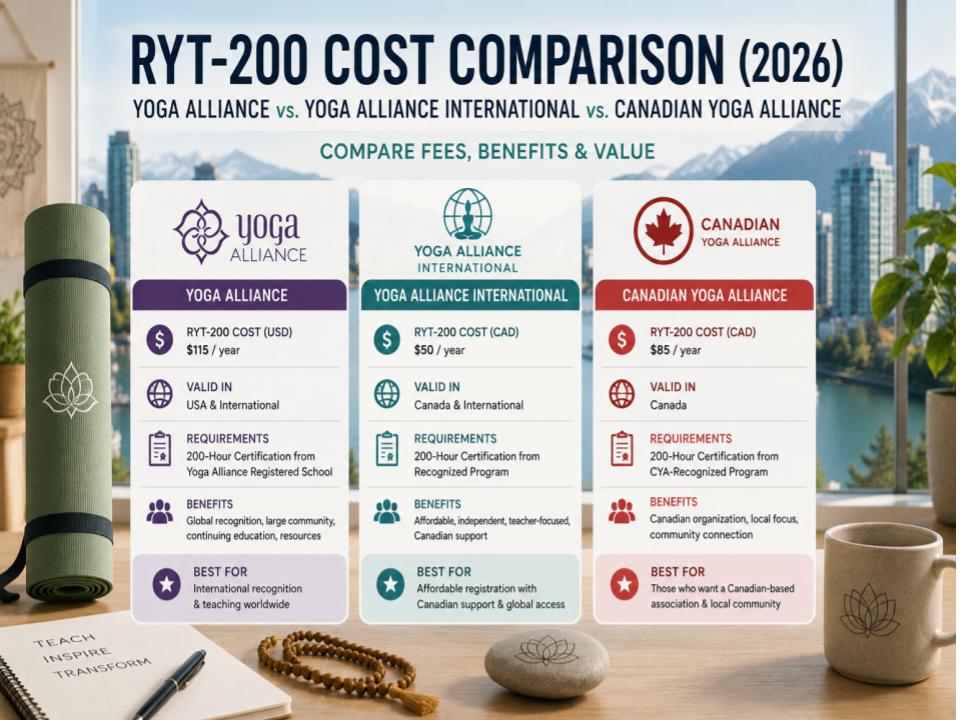
This guide breaks down the real costs of registering as an RYT-200 in 2026. We compare three registries: Yoga Alliance (USA), Yoga Alliance International (Canada), and the Canadian Yoga Alliance (CYA). We cover first-year fees, annual renewal costs, five-year totals, what you get for your money, and who each option suits best.
No fluff. Just the numbers and the facts you need to make a smart decision.
What Is an RYT-200 and Why Does It Matter?
RYT stands for Registered Yoga Teacher. The “200” refers to the number of training hours you completed — specifically a 200-hour foundational yoga teacher training program.
The credential does not come from finishing a course alone. It comes from registering with a yoga alliance or private registry after you graduate. The registry verifies your training, lists you in a public teacher directory, and grants you the right to use the RYT title professionally.
Three reasons this matters in practice:
Insurance access. Many liability insurance providers offer better rates — or exclusive policies — to registered yoga teachers. If you teach privately, in a studio, or at events, insurance is not optional.
Studio hiring. Most reputable yoga studios across Canada and globally prefer or require registered teachers. The RYT-200 is the minimum standard for most studio employment. Without it, you are competing at a disadvantage.
Global mobility. A recognized RYT credential travels with you. It opens doors at international retreat centres, wellness resorts, cruise ship programs, and online platforms that verify teacher credentials before hiring.
No government in Canada licenses yoga teachers the way it licenses nurses or physiotherapists. There is no federal or provincial statute requiring yoga registration. Private registries set the professional standard instead. That means your choice of registry is a business decision — and cost is a major factor in that decision.
The Three Registries at a Glance
Before diving into fees, it helps to understand what each organization is and where it operates.
Yoga Alliance is based in the United States. Founded in 1999, it is the oldest and most widely recognized yoga registry by name globally. When studios internationally ask for a “Yoga Alliance certification,” they are usually referring to this one. It is a US non-profit and charges fees in USD.
Yoga Alliance International is a Canadian registry with global recognition. It operates internationally and offers one of the most straightforward, affordable fee structures of the three. Fees are charged in CAD. It accepts training certificates from a wide range of programs and does not require your school to be on its own registered list.
Canadian Yoga Alliance (CYA) is Canada’s longest-running domestic yoga registry, established in 2002. It focuses on the Canadian market and offers strong benefits for teachers practising in Canada, including a partnership with HUB International for liability insurance. Fees are charged in CAD.
 Yoga Alliance (USA): Fees, Structure, and What You Get
First-Year and Annual Costs
Yoga Alliance charges in USD. Here is the current breakdown for an RYT-200 registration:
- One-time registration fee: USD $50
- Annual membership dues: USD $65
- First-year total: USD $115
After year one, the annual renewal fee is USD $65 per year. At the time of writing, that converts to approximately CAD $88–$95 depending on the exchange rate.
Five-Year Cost (USD)
| Year | Cost |
|---|---|
| Year 1 | $115 (registration + dues) |
| Year 2 | $65 |
| Year 3 | $65 |
| Year 4 | $65 |
| Year 5 | $65 |
| Total | $375 USD |
At a USD/CAD rate of approximately 1.38, that is roughly CAD $517 over five years.
Continuing Education Requirements
Yoga Alliance requires you to complete 30 hours of continuing education every three years to maintain your credential. These must be completed through a Yoga Alliance-approved continuing education provider (YACEP). If you miss this requirement, your registration lapses.
This is an ongoing time and financial commitment on top of annual dues. Continuing education courses vary widely in cost — from free webinars to paid workshops and courses.
What You Get
- A listing in the Yoga Alliance global teacher directory, which is large and well-trafficked
- The right to use the globally recognized RYT-200 designation
- Access to member resources, discounts, and professional development materials
- Liability insurance access through third-party providers
Who It Suits
Yoga Alliance USA is the right choice if your primary career goal is global mobility. It is the most recognized registry by name among international studios, hotels, retreat centres, and corporate wellness programs. If you plan to teach in the USA, Europe, or Asia, this credential is universally understood.
The trade-off is ongoing cost. The annual renewal fees add up over time. Teachers who register but then question whether the value matches the annual fee are common. If you teach primarily in Canada and do not plan to market internationally, you may be paying a premium for name recognition you don’t need day-to-day.
Yoga Alliance International: Fees, Structure, and What You Get
First-Year and Annual Costs
Yoga Alliance International charges in Canadian dollars. Its fee structure is among the most affordable available:
| Designation | 1 Year (CAD) | 3 Years (CAD) | 5 Years (CAD) |
|---|---|---|---|
| RYT-200 | $50 | $120 | $175 |
| ERYT-200 | $50 | $120 | $175 |
| RYT-500 | $50 | $120 | $175 |
| ERYT-500 | $50 | $120 | $175 |
All teacher designations are priced the same. There is no separate first-year registration fee. You pay one flat fee.
Five-Year Cost (CAD)
$175 CAD total if you choose the five-year option. That is the complete cost for five years of registration — no hidden fees, no per-year renewal billing, no continuing education requirement to maintain your credential.
Alternatively: $50/year × 5 years = $250 CAD if you renew annually. The multi-year options represent significant savings.
Continuing Education Requirements
Yoga Alliance International does not require continuing education hours to maintain your RYT-200 registration. This is a meaningful distinction. You will not face a CE audit or risk losing your credential because you missed a workshop.
This makes YAI particularly attractive for teachers who are actively teaching and developing organically — rather than collecting formal CE credits.
Training Flexibility
One of Yoga Alliance International’s most notable features is its open training recognition. Applicants can register if they completed:
- A 200-hour program registered with Yoga Alliance International
- A 200-hour program from another recognized yoga organization
- Equivalent training or substantial teaching experience through a grandfathering pathway
This means graduates of Yoga Alliance (USA) registered schools, CYA-registered schools, and many independent programs are eligible to register with YAI directly. You do not need to retrain.
 What You Get
- A listing in the YAI global teacher and school rosters
- The right to use the internationally recognized RYT-200 designation
- A transparent, affordable fee structure with multi-year savings
- No mandatory continuing education to maintain registration
- A globally recognized credential accepted by studios, insurance providers, and employers worldwide
Who It Suits
Yoga Alliance International suits teachers who want a globally recognized credential without the ongoing financial burden of annual USD fees and mandatory CE requirements. It is an excellent option for Canadian teachers at every career stage — from newly certified graduates looking for affordable entry into professional registration, to experienced teachers who want straightforward, low-cost renewal.
It is also ideal for teachers who trained at a school that is not specifically registered with one single alliance. The flexible training recognition means more graduates can qualify.
Ready to register with Yoga Alliance International? Review the RYT-200 standards and apply here.
Canadian Yoga Alliance (CYA): Fees, Structure, and What You Get
First-Year and Annual Costs
The Canadian Yoga Alliance charges in Canadian dollars. Here is the current fee structure for the core teacher designations:
| Designation | Initial Fee (CAD) | Annual Renewal (CAD) |
|---|---|---|
| CYA-IR (Basic Registration) | $109 | $99 |
| CYA-RYT 200 | $109 | $99 |
| CYA-E-RYT 200 | $119 | $109 |
CYA graduates who trained at a CYA-registered school receive a 30% discount on registration. Your school provides a discount code before you sign up — ask for it before registering.
Five-Year Cost (CAD) — CYA-RYT 200
| Year | Cost |
|---|---|
| Year 1 | $109 |
| Year 2 | $99 |
| Year 3 | $99 |
| Year 4 | $99 |
| Year 5 | $99 |
| Total | $505 CAD |
With the 30% school discount applied to year one: approximately $76.30 for year one, bringing the five-year total to roughly $472 CAD.
Training Flexibility
Like YAI, the Canadian Yoga Alliance does not require your training to come from a CYA-registered school. Teachers with certificates from non-CYA schools can register at full price. If your school is CYA-registered, you save 30% on your registration fee.
No teaching hours are required to register at the RYT-200 level.
Insurance Access
This is a major CYA advantage. The Canadian Yoga Alliance partners with HUB International to offer liability insurance to its members. This partnership provides some of the most accessible and competitively priced yoga teacher insurance available in Canada.
If you plan to teach privately, run workshops, or work as an independent contractor, having a direct insurance pathway through your registry is genuinely valuable. It simplifies your setup considerably.
Community and Canadian Focus
CYA has operated since 2002. It runs a job board, continuing education listings, and a member community through CanadianYogi.com. Members can submit free advertising for upcoming programs and products. CE workshops for members are offered at no additional cost.
CYA also offers a significantly broader range of training designations than other registries — from RYT-200 all the way through RYT-Gold (1,000+ hours), with grandfathering pathways for experienced teachers who don’t hold formal certifications. This makes it a strong long-term home for teachers who want to grow their designation over time within a single registry.
What You Get
- A listing in the CYA teacher directory
- The right to use the CYA-RYT 200 designation
- Access to HUB International insurance partnership
- Free CE workshops and advertising through CanadianYogi.com
- A job board and Canadian teacher community
- A 30% discount if you trained at a CYA-registered school
Who It Suits
CYA suits teachers who are building their careers primarily in Canada and want strong domestic infrastructure — particularly insurance access. It is also the right fit for teachers who want to grow their designation through continuing training over time, given the range of CYA credential tiers.
If your studio network, student base, and teaching market are all in Canada, CYA provides focused, relevant support that a US-based registry simply cannot match in the same way.
 Side-by-Side Cost Comparison: 5-Year Total
Here is a direct comparison of the five-year cost for an RYT-200 registration across all three registries:
| Registry | Currency | Year 1 | Annual Renewal | 5-Year Total |
|---|---|---|---|---|
| Yoga Alliance (USA) | USD | $115 | $65/year | ~$375 USD (~CAD $517) |
| Yoga Alliance International | CAD | $50 | $50/year (or $175 flat for 5 years) | $175–$250 CAD |
| Canadian Yoga Alliance | CAD | $109 | $99/year | ~$505 CAD |
Yoga Alliance International is the most affordable option over five years, by a significant margin — particularly if you choose the five-year flat-rate package at $175 CAD.
Comparing the Hidden Costs: Continuing Education Requirements
Cost comparisons don’t end at registration fees. Continuing education requirements create real financial obligations.
Yoga Alliance (USA)
Requires 30 hours of CE every 3 years. These must come from approved Yoga Alliance Continuing Education Providers (YACEPs). While some CE programs are free, many are not. A single 10-hour workshop can cost $100–$300 or more. Over five years, mandatory CE adds a meaningful additional cost that most first-time registrants don’t factor in.
Yoga Alliance International
No mandatory CE requirement. You maintain your registration through renewal fees alone. You can pursue continuing education on your own terms and timeline — without the pressure of meeting a quota to keep your credential active.
Canadian Yoga Alliance
CYA does not mandate CE hours to maintain your RYT-200 registration. However, to upgrade to higher designations (E-RYT levels), you will need to log teaching hours and potentially additional training. For basic RYT-200 maintenance, CE is optional.
Which Registry Is Recognized Where?
This is the question teachers ask most often. Here is a practical breakdown.
Yoga Alliance (USA) is the most widely recognized registry by name internationally. Studios in Europe, Southeast Asia, and the Americas frequently list “Yoga Alliance certified” as a requirement. In most cases, they mean this one. If you plan to teach internationally or market yourself to students who are comparing credentials online, this is the credential with the highest immediate name recognition.
Yoga Alliance International is globally recognized and accepted by studios, insurance providers, and employers worldwide. It is an international registry — not a Canadian-only credential. Teachers registered with YAI work in Canada, the USA, Europe, and globally. It has a growing roster and is particularly well-established in Canada.
Canadian Yoga Alliance carries strong recognition within Canada. It is widely known by Canadian studio owners and is the registry most associated with Canadian-specific insurance partnerships. If you are based in Canada and teaching a Canadian student base, CYA’s recognition is entirely sufficient for your needs. For international markets, it is less universally known by name than Yoga Alliance USA.
Can You Register with More Than One?
Yes. Nothing prevents you from registering with multiple registries, and some teachers choose to do so. The most common combination is registering with both Yoga Alliance International and Yoga Alliance (USA) — keeping a cost-efficient Canadian registration as the primary, while maintaining US Yoga Alliance membership for name recognition in international contexts.
If you do register with multiple organizations, factor in the combined annual cost. Paying two sets of renewal fees makes sense for some career paths and not for others. Be honest about your actual teaching market before committing to multiple dues.
 What About Insurance?
Your choice of registry may directly affect your insurance options.
Canadian Yoga Alliance has the clearest insurance story. Their partnership with HUB International gives members direct access to affordable liability coverage designed for yoga teachers in Canada. This is a meaningful perk that simplifies the setup for new teachers.
Yoga Alliance International teachers can obtain insurance through various Canadian and international providers that recognize the YAI designation. Many Canadian yoga insurance providers accept YAI credentials. Check directly with your preferred insurer before registering.
Yoga Alliance (USA) registration similarly qualifies you for insurance through third-party providers, including several available to Canadian teachers. The YA designation is widely understood by insurers. However, there is no exclusive partnership comparable to CYA’s HUB arrangement.
If securing affordable Canadian insurance quickly is your priority, CYA has a clear advantage. If you want to shop for the best insurance rate independently, all three registries provide sufficient credential recognition with most major yoga insurance providers.
The Real Question: What Do You Actually Need?
Every teacher’s situation is different. Here is a practical framework.
Choose Yoga Alliance (USA) if:
- You plan to teach internationally and want universal name recognition
- Your target employers specifically list “Yoga Alliance” as a credential requirement
- You can absorb the ongoing USD fees and CE requirements
Choose Yoga Alliance International if:
- You want an affordable, globally recognized credential without mandatory CE requirements
- You trained at a school not specifically registered with one single alliance
- You want the flexibility of multi-year registration at a fixed, low cost
- You teach in Canada but want a credential recognized globally
Choose Canadian Yoga Alliance if:
- You teach primarily in Canada and want strong domestic community and support
- Insurance access through HUB International is a priority for you
- Your training school is CYA-registered (saving you 30% on registration)
- You want to build through a range of Canadian credential tiers over time
A Note on “Yoga Alliance” Name Confusion
Many teachers and students use the phrase “Yoga Alliance certified” loosely. It often refers to any yoga alliance registry — not specifically the US-based organization. This creates confusion.
When a studio or employer asks if you are “Yoga Alliance certified,” it is worth clarifying which registry they mean. In most cases, they simply want evidence that you completed a recognized, structured teacher training program and are registered with a credible professional body. All three registries discussed here meet that standard.
As the yoga industry continues to evolve, the landscape of recognized registries is broadening. The monopoly that Yoga Alliance (USA) once had on the term is softening as more registries gain legitimate standing internationally.
Summary: Real 2026 Costs at a Glance
| Registry | 1-Year Cost | 5-Year Cost | CE Requirement | Insurance Partnership |
|---|---|---|---|---|
| Yoga Alliance (USA) | ~CAD $159 | ~CAD $517 | 30 hrs per 3 years | Third-party only |
| Yoga Alliance International | CAD $50 | CAD $175 (flat) | None | Third-party accepted |
| Canadian Yoga Alliance | CAD $109 | ~CAD $505 | None (for RYT-200) | HUB International |
USD/CAD conversion approximate at time of writing.
Conclusion: RYT-200 Cost Comparison — Yoga Alliance vs Yoga Alliance International vs Yoga Alliance Canada (2026)
The right registry depends on your teaching market, your budget, and what you need most right now.
Yoga Alliance International is the most cost-effective option, with five years of registration available for $175 CAD — no hidden fees, no mandatory CE, and globally recognized credentials. It suits most Canadian teachers well, particularly those who want low-cost access to professional standing without ongoing financial obligations.
Canadian Yoga Alliance is the right fit for teachers building careers in Canada who want integrated insurance access and a Canadian teacher community. The fees are moderate and the domestic infrastructure is strong.
Yoga Alliance (USA) is the best choice if international name recognition is a genuine career priority and you are willing to pay ongoing USD fees and meet CE requirements to maintain that global standing.
Whichever you choose, registering matters. It opens insurance access, studio opportunities, and professional credibility that compound over your teaching career.
Ready to register as an RYT-200 with Yoga Alliance International? Review our full RYT-200 standards page to see the requirements and begin your application today.
Register with all three directly: